 International naval forces operating as part of the Combined Task Force 150 (CTF 150) have reported a significant increase in meth seizures in their area of operations in 2019 (which encompasses a wide swathe of the Indian Ocean, the Persian Gulf and the Gulf of Aden). As of late December 2019, the force had seized 257kg of meth – including one seizure in the Arabian Sea from a dhow carrying 94kg of heroin and 76kg of crystal meth in October 2019 – compared to only 9kg of meth seized in 2018.
Similarities found between different seizures appear to suggest an interlinked supply chain for meth and heroin. In December 2019, a Pakistani-crewed dhow was intercepted off the coast of Pemba, Mozambique, carrying a mixed cargo of both heroin and 299kg of methamphetamine. Pemba is known to be a major port of entry on the East African coast for dhows – predominantly from the coast of Iran and Pakistan – carrying heroin, yet this mixed shipment of meth was the first of its kind in Mozambique.
Several months later, in May 2020, a cargo truck was intercepted by the South African Police Service attempting to cross the Mozambican border into South Africa at the Komatipoort border post while carrying a large shipment of heroin and methamphetamine.
Elsewhere, Sri Lankan naval forces intercepted two trawlers in international waters carrying 400kg of heroin and 100kg of crystal methamphetamine in February 2020 – Sri Lanka’s biggest-ever drug bust at sea. Eight Pakistani nationals were detained in the operation, and investigations suggested the boats came from Pakistan’s Makran coast, with the drugs presumed to have originated in Afghanistan. The vessel was allegedly headed to a transit stop in Penang, Malaysia, for onward transfer of the cargo to Australia, where meth prices are very high.
 Heroin and methamphetamine seized by the Sri Lankan navy from two Pakistani fishing trawlers in February 2020. The heroin bricks, on the left, share numerous characteristics with the heroin seized in Durban. © Sri Lankan Navy
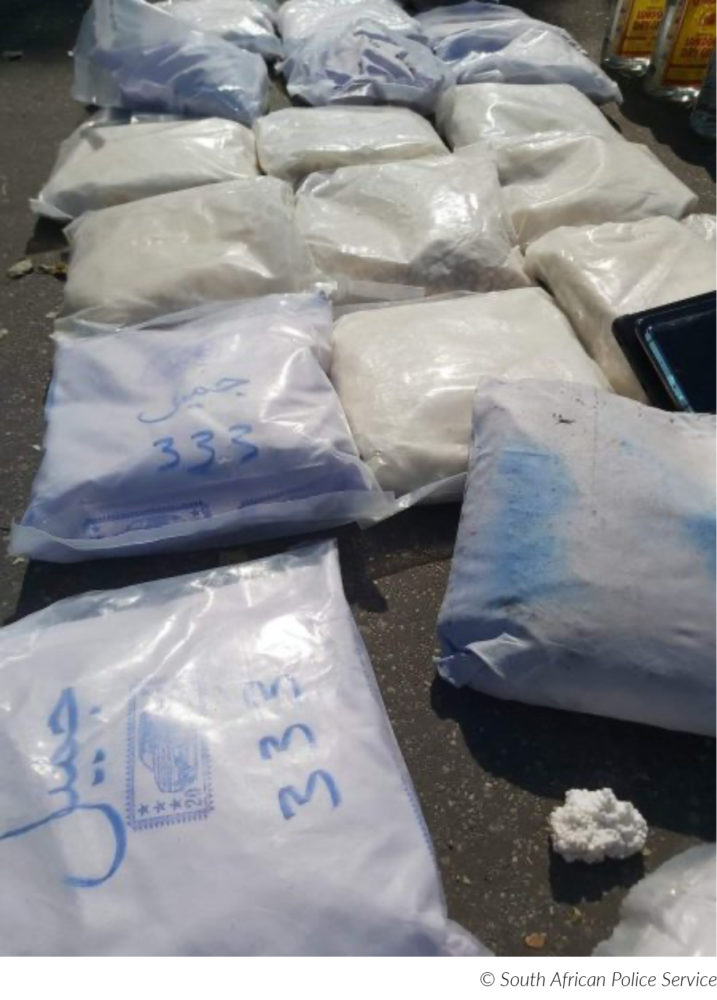
 In July 2020, a GI-TOC research team took images of a heroin shipment that had just been delivered in Durban, South Africa. Similar images were taken of a joint heroin and meth shipment that had arrived in Cape Town. Each of these shipments was in the process of being unbundled in advance of their contents’ preparation for the local retail market. Wrapped in thick whitish plastic bags of 1kg denominations, the packaging was stamped with distinctive blue markings reading “Pa Pa Jone 100%” and “5161”. These markings are consistent across each of the dual-commodity seizures mentioned above: the drugs seized from the dhow in Mozambique in 2019, those seized at the Komatipoort border crossing and those seized by the Sri Lankan Navy, suggesting a common origin for these shipments.
Interviews by GI-TOC researchers with local meth users and distributors in Cape Town in August 2020 saw informants confirm that a new source of meth had entered the South African market “in the past eight to 10 months”. Described by both groups as “Pakistani meth”, this new supply appears to be provided through local South Asian syndicates based in South Africa and Mozambique, connecting with suppliers in Pakistan. The purity of this new supply of “Pakistani meth” is seen by South African users as being quite high, “just as good” as the Mexican-produced crystal meth arriving from Nigeria and better than the Chinese-produced meth that is manufactured in locations around Johannesburg.
Altogether, this combination of factors may help us towards understanding where Afghanistan-produced meth is ultimately headed. Pre-existing infrastructure and flow channels along traditional heroin routes – the dhow crews involved in trafficking, the ports whereby shipments can be landed without detection and the connections to distributors in southern Africa – have enabled this supply chain to emerge, while recent seizures provide strong circumstantial evidence that suggests Afghan meth is transiting Mozambique and has now become an emergent commodity option in the growing South African meth market. New high-quality crystal meth flows which seem to be appearing recently in Malawi, Tanzania and Kenya may suggest this new development is also a regional phenomenon. DM
This article appears in the Global Initiative Against Transnational Organised Crime’s monthly East and Southern Africa Risk Bulletin.
The Global Initiative is a network of more than 500 experts on organised crime drawn from law enforcement, academia, conservation, technology, media, the private sector and development agencies. It publishes research and analysis on emerging criminal threats and works to develop innovative strategies to counter organised crime globally. To receive monthly Risk Bulletin updates, please sign up here.
 AVISEUR INTERNATIONAL