Aviseur International renseigne, sans complaisance, sur la problématique de la drogue, du narcotrafic, de la corruption et sur les politiques mises en œuvre par les différents Etats et les dérives que s'autorisent les fonctionnaires des administrations — aviseurinternational@proton.me — 33 (0) 6 84 30 31 81
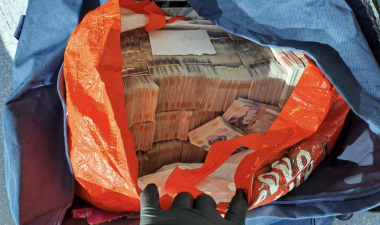
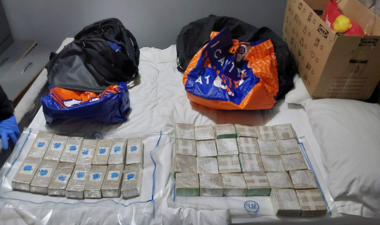
Un homme accusé de blanchiment d’argent, il a été inculpé dans le cadre d’une enquête de la NCA après la saisie d’un million de livres sterling par les Border Force à l’aéroport d’Heathrow.
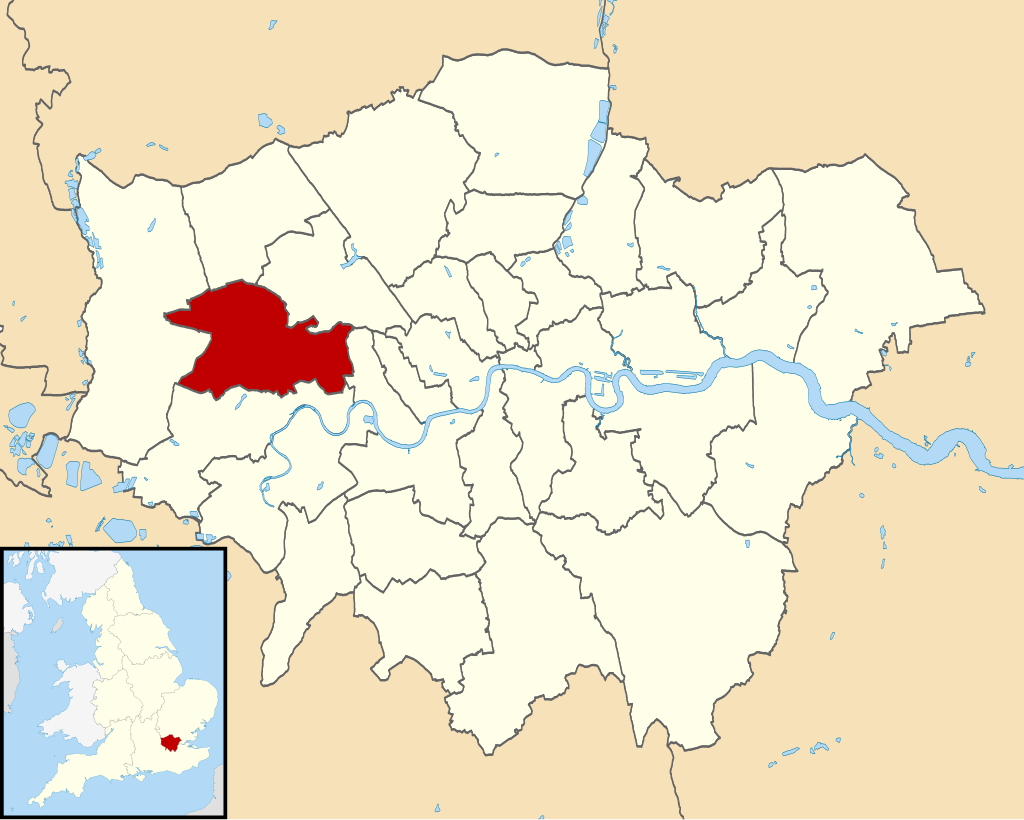
Mazen Al Shaar, 48 ans,de Hayes, Middlesex, a été arrêté samedi par des agents des forces frontalières alors qu’il devait s’envoler pour Beyrouth. L’argent a été saisi. Il a comparu lundi devant le tribunal de première instance d’Uxbridge. Une demande de libération sous caution a été refusée et il a été placé en détention pour comparaître à la Crown Court d’Isleworth le 17 avril pour une audience de plaidoyer préalable au procès.
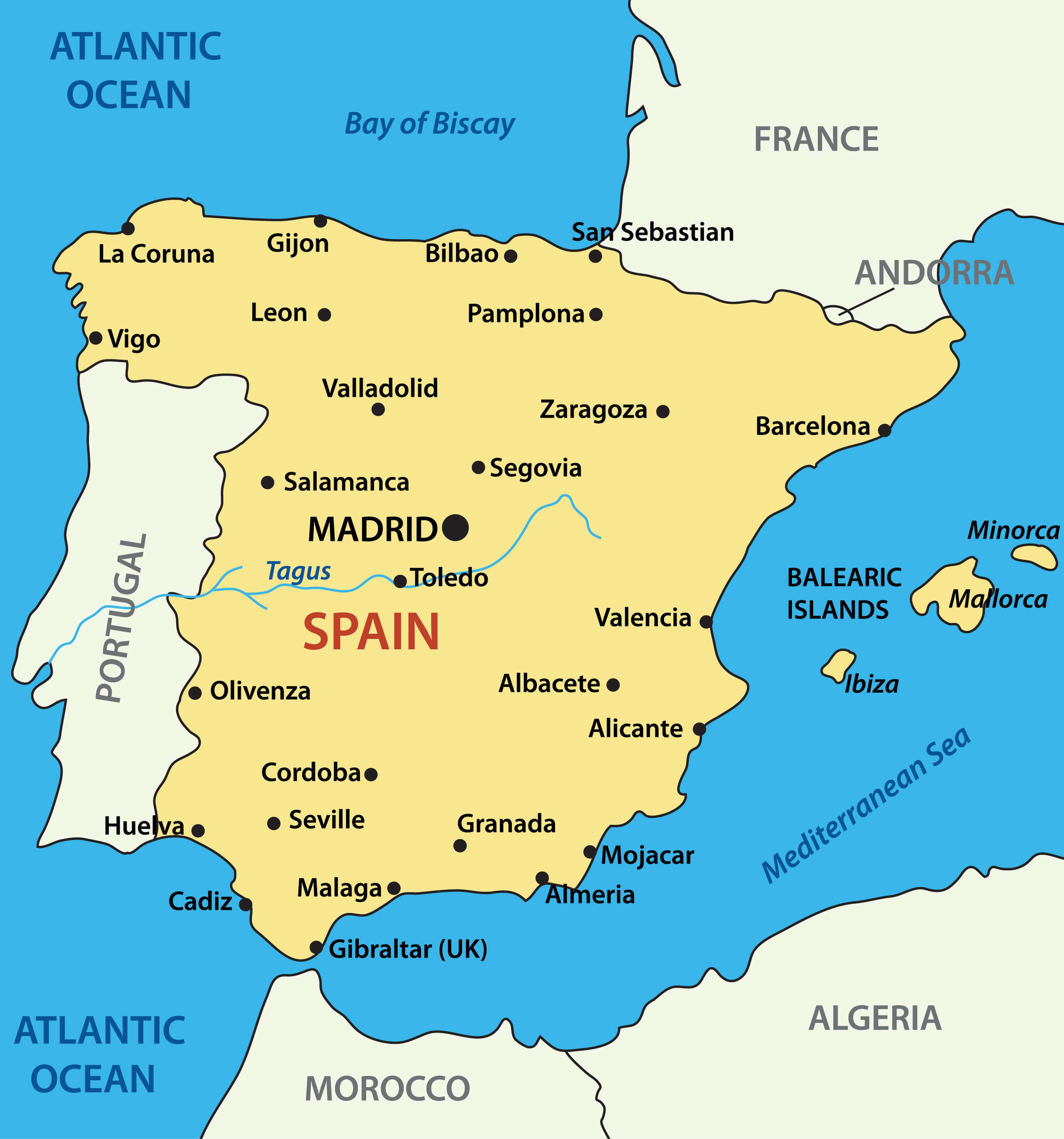
La Galice est revenue sur le devant de la scène en précisant que l’Andalousie rivalise déjà avec elle en tant que porte d’entrée majeure. Les drogues colombiennes n’ont jamais été aussi bon marché. Derrière ce boom, outre la surproduction en Amérique latine et la demande brutale de stupéfiants en Europe, se cache un système alimenté par l’argent noir et dirigé par des criminels en col blanc qui protègent les narco-organisateurs des poursuites de la police.
L’année 2023 a marqué des records historiques en matière de saisies de cocaïne en Espagne
Plus de 140 tonnes, selon les données fournies par la Sécurité intérieure à l’époque. Cependant, les prix ont continué à baisser. Quelque chose n’allait pas. La police a localisé le plus grand laboratoire de production de drogue colombien jamais découvert en Europe, à Cerdedo-Cotobade, mais, au même moment, des trafiquants de drogue transportaient en douce 5 000 kilos de cocaïne dans un narco-sous-marin. L’année s’est terminée par d’importantes saisies de conteneurs, tant à Algésiras (9,5 tonnes) qu’à La Corogne (7,5 tonnes). Aux tables de négociation des grands patrons, le prix de la reine des drogues a cependant continué de baisser.
En 2024, les chiffres des saisies ont diminué, mais sont restés très élevés
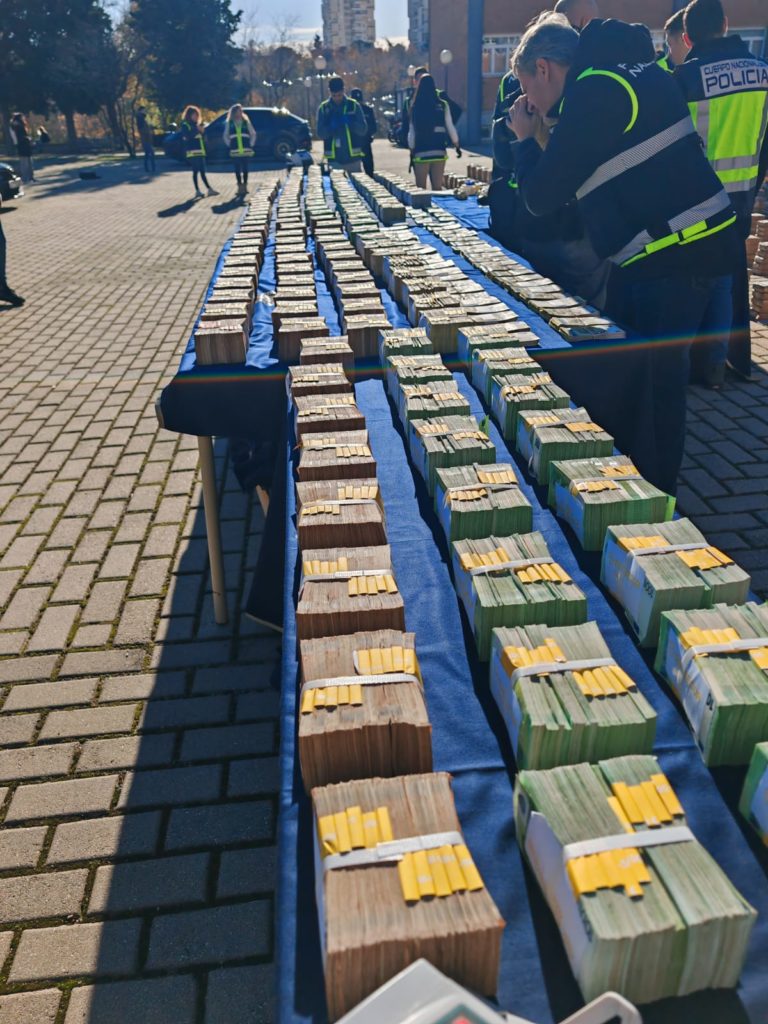
Les autorités ont réussi à atteindre certains des prétendus barons de la drogue « invisibles » en Galice et dans d’autres régions d’Espagne, dans le cadre d’opérations qui, cependant, sont restées inachevées. Les images de millions d’euros entre les mains de trafiquants de drogue ont attiré l’attention, d’abord dans les Rías Baixas, puis, plus encore, à Madrid.
Les 20 millions d’euros trouvés dans la maison de Óscar Sánchez Gil, un policier qui collaborait avec des trafiquants de drogue auraient pu servir d’avertissement, tout comme les 13 000 kilos de cocaïne saisis en novembre dans la plus grande cargaison de drogue jamais vue en Espagne.
Les narcos continuent de travailler et ils le font partout
Le déchargement de drogue en plein jour, sécurisé par des tueurs à gages armés de kalachnikovs, sur le quai de Las Carabelas à Huelva, en est l’exemple le plus clair.
Les forces de l’ordre continuent d’obtenir des résultats, certains trafiquants de drogue finissent en prison, mais le commerce continue de prospérer, peut-être plus fort que jamais.
Pour comprendre les causes de ce qui se passe, au-delà de la surproduction déjà éculée en Amérique latine et de la demande extrêmement forte en Europe, il faut analyser un nouveau scénario, largement révélé par le décryptage des communications des principaux trafiquants de drogue à travers les plateformes Sky-ECC, Encrochat et Anom, et, plus récemment, d’autres comme Ghost. Dans le monde du crime organisé, les criminels en col blanc ont proliféré, jouant un rôle crucial dans le maintien de l’activité et l’augmentation de leurs profits : ceux qui se livrent à la tromperie, à la corruption et à la fraude, faisant des victimes partout où ils vont, aussi bien parmi les personnes honnêtes que parmi les trafiquants de drogue eux-mêmes.
Des accords avec les autorités judiciaires
Les forces de sécurité et le Bureau du Procureur général, conscients de ce qui se passe, ont mis en place des mécanismes d’alerte pour faire face à un ennemi qui reste souvent sans visage, ou qui a de nombreux visages différents. Certains d’entre eux sont des avocats, selon des sources policières très fiables, mais dans d’autres cas, il s’agit simplement d’individus offrant leurs services à diverses organisations criminelles. Ils assurent la sécurité et la solvabilité des trafiquants de drogue, allant jusqu’à conclure des accords avec les autorités judiciaires qui aboutiraient à des réductions de peine. Et ils citent comme exemple des situations vécues en Galice et en Andalousie, principalement, mais aussi à Madrid, au Levant et en Catalogne : des arrestations et des saisies sont réalisées, mais de grands barons de la drogue, certains n’ont jamais été condamnés, d’autres continuent de faire passer en contrebande de la cocaïne ou du haschisch en quantités sans précédent. Et ils semblent intouchables…
En 2025, en Galice, des proches des barons de la drogue proposent de « remettre » un narco-sous-marin en échange de faveurs dans la phase procédurale d’autres affaires
En Andalousie, le cas de l’ancien chef de l’OCON Sur, l’unité d’élite de la Guardia civil, continue de perturber la scène. La vérité est que les fleuves Guadiana et Guadalquivir sont devenus une importante autoroute de la cocaïne, et alias Yeyo, l’auteur présumé d’une grande partie du trafic de drogue dans cette région, est toujours en liberté. Son nom apparaît en première page des cibles du groupe de travail anti-drogue. Plusieurs sources indiquent que des déchargements comme celui du quai de Las Carabelas portent son sceau. Ancien pilote de bateau à moteur, la Formule 1 des mers, il aurait utilisé ces compétences pour se faire un nom, d’abord comme batelier et maintenant comme patron présumé. On voit également à l’arrière-plan « Le Messi du haschisch », qui se trouve à Tanger et tire les ficelles. On dit qu’il aurait livré l’auteur du crime de Barbate en échange d’être laissé tranquille. Et ce n’est pas exclu. Et puis il y a Dubaï. Les vols aller-retour de l’aéroport de Barajas vers les Émirats arabes unis reçoivent un flux constant de ces individus offrant des services qui profitent à quelques-uns et nuisent à beaucoup d’autres. Ils cherchent à atteindre les plus hauts niveaux possibles, les échelons supérieurs des organisations internationales, pour leur « vendre » l’immunité dont ils bénéficient déjà de facto. Dans ces affaires, les criminels de moindre envergure s’en sortent souvent mal et sont eux-mêmes arrêtés. Et pendant ce temps, ils réalisent des bénéfices dans différents scénarios.
Le policier avec les 20 millions d’euros chez lui
Derrière le trafic international de drogue, un seul élément compte pour les grandes mafias : l’argent qu’elles peuvent gagner. C’est pourquoi ils n’hésitent pas à utiliser tous les moyens à leur disposition pour maintenir leur entreprise à flot et, si possible, la faire croître de jour en jour. Un exemple très illustratif de l’ampleur avec laquelle ce réseau de tromperies et de mensonges a influencé l’escalade des envois de cocaïne non seulement en Espagne, mais dans tout le monde occidental, a été la chute de Óscar Sánchez Gil, l’inspecteur responsable du blanchiment d’argent à la Direction Générale de la Police de Madrid. Son arrestation, dans le cadre d’une opération conjointe entre les Affaires intérieures et la Brigade centrale des narcotrafiquants de l’Udyco Central, fait suite à la saisie de 13 000 kilos de drogue colombienne dans un conteneur au port d’Algésiras, la plus grande cargaison jamais saisie sur le sol espagnol à ce jour.
Ce policier, qui a caché les fameux 20 millions d’euros dans le mur de sa maison, était depuis longtemps employé par diverses organisations criminelles. La tromperie et les mensonges ont permis à ces cargaisons d’entrer dans le pays.
Les experts : « C’est un jeu de portes qui s’ouvrent et se ferment et de vols qui vont et viennent. »
Après avoir rencontré des experts en application de la loi qui reconnaissent la capacité de divers acteurs à tirer les ficelles en coulisses, ce qui, dans la plupart des cas, aboutit à tromper les autorités, à l’emprisonnement de certains trafiquants et à l’impunité d’autres. « Ils fournissent rarement des informations sur les drogues. C’est juste un jeu de portes qui s’ouvrent et se ferment, de vols qui vont et viennent », expliquent les experts.
Les rencontres en face à face à Madrid, Marbella, en Galice et surtout à Dubaï font partie de la routine des personnes liées au trafic de drogue.
Dans la plupart des cas, il s’agit d’avocats ou de professionnels qui se rendent légalement à un endroit ou à un autre pour exercer leur profession conformément au cadre juridique en vigueur. Mais certains opèrent sur la fine ligne entre le bien et le mal, en profitant toujours à ceux qui ont le plus d’argent : les grands patrons, ceux qui continuent d’opérer dans les zones susmentionnées sans offrir aucune opportunité aux forces de sécurité.
« Souvent, ce ne sont que des mensonges que les procureurs et la police ne croient généralement pas », soulignent les autorités, qui avertissent que « ces avances en espèces ne débouchent souvent sur rien de concret. Les trafiquants de drogue qui ne veulent pas aller en prison paient pour garder espoir, même s’il est limpide. »
Dans ce contexte, le commerce de la cocaïne continue de prospérer avec très peu de surveillance.
Des sous-marins de la drogue arrivent en Galice et déchargent de la drogue en toute impunité, des bateaux de la drogue remontent les fleuves Guadiana et Guadalquivir, et toute cette drogue finit dans des endroits aussi éloignés que Murcia, Madrid, Hendaye, Paris et Rome en quelques heures.
Pour Marc Fievet, dans le même temps, en France, les autorités (Douane – Gendarmerie – Police) subliment désormais en matière de communications destinées à tromper les citoyens sur les moyens qu’elles mettent en œuvre pour lutter réellement contre le fléau de la drogue.
Ce sont des agents de l’Organised Crime Partnership – une unité conjointe de la National Crime Agency et du Metropolitan Police Service – qui ont arrêté Gleni Goleci, 27 ans, sur Pottery Road, à Kew, en janvier de cette année.
Gleni Goleci
Goleci, un immigré clandestin albanais sans domicile fixe au Royaume-Uni, a été arrêté et accusé de délits liés à la drogue et de possession de biens criminels. Il a plaidé coupable devant la Crown Court d’Isleworth le 6 février et a été immédiatement condamné à sept ans et demi d’emprisonnement.
En fouillant le véhicule Hyundai que conduisait Gleni Goleci, les agents ont trouvé 1,5 kilo de cocaïne et environ 20 000 £ en espèces planqué dans le coffre via un dispositif sophistiqué . Les agents de l’OCP ont également fouillé un appartement à Holland Gardens, à Brentford, et ont trouvé six kilos de cocaïne et environ 60 000 £ en espèces. La drogue avait été cachée derrière un canapé et dans un placard. Ils ont également trouvé une réplique de pistolet à air comprimé Colt et du matériel associé à l’approvisionnement en drogue, notamment une balance, un couteau, un carnet avec une « liste de choses à faire » et une grande boîte de gants jetables.
Bernard Narh, 34 ans, de South Oxhey, Hertfordshire, a été arrêté par des agents de l’Organized Crime Partnership – une unité conjointe de la National Crime Agency et du Metropolitan Police Service – mardi 28 janvier.
Il a été accusé de possession de drogue après que les agents ont découvert plus de 140 blocs d’héroïne après la perquisition d’ un appartement à Ealing.
Il a comparu le 30 janvier devant le tribunal de première instance d’Uxbridge, et il a été placé en détention provisoire avant sa prochaine comparution devant le tribunal de la Couronne d’Isleworth le 27 février.
Des agents de l’Organised Crime Partnership – une unité conjointe de la National Crime Agency et du Metropolitan Police Service – ont arrêté le ressortissant albanais Gleni Goleci, 27 ans, sur High Street, à Brentford, mardi (7 janvier).
Ils ont fouillé le véhicule qu’il conduisait et ont trouvé deux kilos de cocaïne et environ 50 000 £ en espèces dans une planque sophistiquée dans le coffre. Les agents de l’OCP ont également fouillé un appartement à Brentford et ont trouvé six kilos de cocaïne et environ 150 000 £ en espèces.
Goleci, un ressortissant albanais, a été arrêté et accusé de délits liés à la drogue et à la possession de biens criminels. Il a comparu hier (9 janvier) devant le tribunal de Westminster, où il a été placé en détention provisoire avant sa prochaine comparution devant la Crown Court d’Isleworth le 6 février.
Quatre membres d’un groupe criminel organisé qui vendait de la drogue et des armes à feu dans le nord de l’Angleterre ont été emprisonnés à la suite d’une longue enquête de la National Crime Agency (NCA). Le groupe était dirigé par Carl O’Flaherty, 39 ans, qui a été emprisonné pendant plus de 17 ans en 2023.
Son entreprise criminelle a été déjouée dans le cadre de l’opération Venetic, la réponse britannique dirigée par la NCA à l’infiltration et au démantèlement de la plateforme de communications cryptées EncroChat.
De 2019 à fin 2020, le groupe criminel organisé a acheté de grandes quantités de cocaïne ainsi que des produits chimiques nécessaires à la fabrication d’amphétamine. La drogue et les produits chimiques étaient transportés à des adresses à Leeds et Bradford où les membres du gang, appelés « chefs », produisaient de l’amphétamine et adultéraient la cocaïne pour la réapprovisionner.
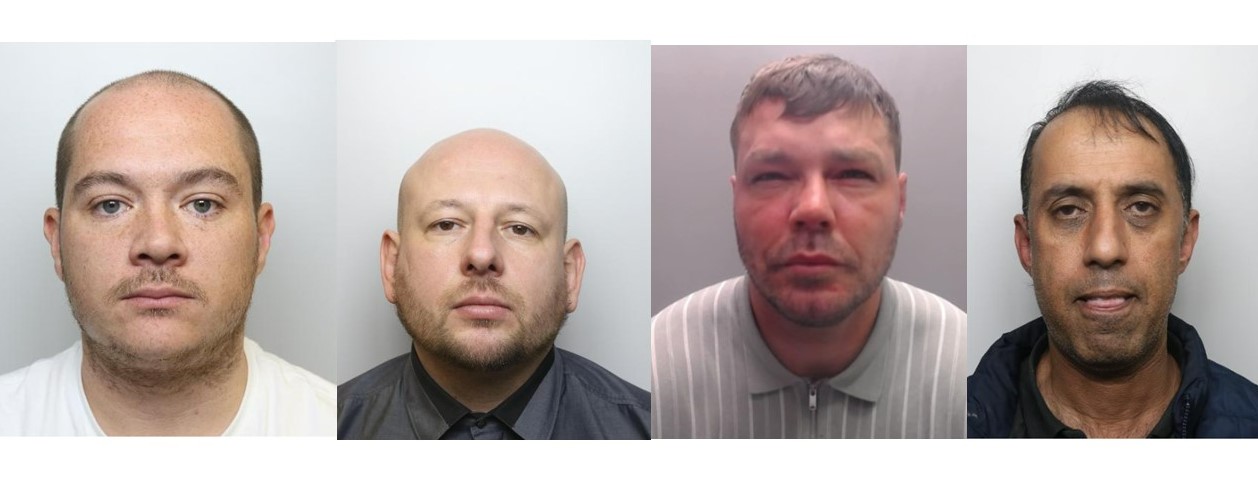
Aujourd’hui, le 7 janvier, trois des assistants d’O’Flaherty et l’un de ses associés criminels ont été condamnés à la Crown Court de Leeds. Ils ont été reconnus coupables de trafic de drogue à l’issue d’un procès de trois semaines en novembre 2024. Michal Stanislawczuk, 39 ans, également connu sous ses pseudonymes EncroChat « Sizabelarm » et « Polishshaman », a été emprisonné pendant 12 ans pour son rôle de chef, qui comprenait une tentative infructueuse d’extraire de la cocaïne dissoute dans 37 litres d’huile. Un autre des chefs du gang, David Brierley, 38 ans, produisait de l’amphétamine et a été démasqué comme étant l’utilisateur derrière le pseudonyme EncroChat « Kingchef-uk ». Il a été emprisonné pendant 12 ans et six mois. Safdar Pervez, 57 ans, est un chauffeur de taxi qui travaillait au noir comme coursier de confiance pour le réseau criminel et opérait dans l’obscurité perçue derrière son pseudonyme EnroChat « Satanicgate ». Pour son rôle dans le transport de grandes quantités de drogue et de dizaines de milliers de livres sterling à travers le nord de l’Angleterre, Pervez a été condamné à 11 ans de prison. L’un de ses déplacements réguliers consistait à se rendre dans le comté de Durham pour livrer des kilos de cocaïne diluée à Daryll Hall, 39 ans, l’un des principaux clients d’O’Flaherty. Hall a été condamné à 15 ans de prison par contumace après s’être enfui avant le début du procès de novembre.
(From L-R: David Brierley, Michal Stanislawczuk, Daryll Hall, Safdar Pervez)
Les enquêteurs de la NCA ont démantelé le complot de drogue après qu’un sac de cocaïne de la taille d’un poing et un combiné EncroChat ont été saisis dans la voiture de l’ancien footballeur Paul Shepherd en avril 2020. Sa maison a été perquisitionnée et les agents ont découvert un pistolet Glock, un fusil de précision à verrou et 213 cartouches. Shepherd a été emprisonné pendant plus de neuf ans en 2023. Les données d’EncroChat ont montré qu’O’Flaherty avait demandé à Shepherd de stocker les armes à feu à son adresse et de déplacer la cocaïne trouvée dans sa voiture. Et une analyse plus approfondie a révélé le modèle commercial du groupe criminel. Alors que l’amphétamine était produite par les « chefs » Stanislawczuk et Brierley sur place dans des propriétés à Leeds et Bradford, la cocaïne de haute pureté était achetée trois kilos à la fois pour 123 000 £. Le produit était ensuite dilué avec des produits chimiques bon marché et revendu par lots de quatre kilos pour 150 000 £ à des revendeurs situés un peu plus bas dans la chaîne d’approvisionnement, comme Hall.
The country’s longest ever running criminal trial heard that an international crime group smuggled billions of pounds of drugs into the UK
Paul Green
Eighteen members of an international organised crime group (OCG) have been convicted after a National Crime Agency investigation into the United Kingdom’s biggest ever detected drugs conspiracy.
The offenders are thought to have smuggled several billion pounds worth of heroin, cocaine and cannabis to the UK.
From south east England to Scotland, crime gangs were fed drugs from the OCG’s importations – which are believed to have contained more than 50 tonnes of drugs -the weight of around 30 family sized cars.
Two criminal trials were needed to try the defendants.
One trial lasted 23 months, a record in England and Wales – the other lasted nine months.
The judge who presided over the trials said the drug smuggling was “on an industrial and hitherto unprecedented scale”.
Today, at Manchester Crown Court, reporting restrictions were lifted upon verdicts in the second trial, and news of the NCA’s operation can be released.
Six seizures of drugs with a total street value of £40m were made from the OCG, which was based in north west England with accomplices in the Netherlands, between the indictment period of August 2015 and September 2018.
But NCA investigators proved there were at least 240 importations by the OCG, which went to great lengths to confuse the authorities and avoid justice.
Trial judge Paul Lawton said if only half of the importations contained the same quantities of drugs as the six recovered seizures, it would amount to £3billion worth.
The OCG was led by Paul Green, 59, (pictured above) who was jailed for 32 years.
It set up a series of front companies and warehouses in England and the Netherlands to mask offending.
And to avoid detection, the OCG concealed its drugs in consignments of strong-smelling foodstuffs such as onions, garlic and ginger. The crime group bought so many onions – between 40 tonnes and 50 tonnes a week, that it couldn’t get rid of them and often sent them back to the continent to act as another cover load.
“The stench of criminality is overpowering,” prosecuting KC Andrew Thomas told the jury as has he opened the case.
The OCG exercised a high degree of criminal tradecraft to evade the authorities.
Green rented a hotel room near his home in Widnes, Cheshire, so he could use its Wi-Fi without it being traced back to him.
Offenders used encrypted communications, faked documents, changed their names by deed poll and acquired live and defunct – but previously legitimate – businesses to disguise their drugs importations.
Companies the OCG was dealing with – suppliers and transport firms – would be far less suspicious about doing business with an organisation appearing to have an established trading history and, in some cases, an existing VAT number.
As well as bringing in his own OCG’s drugs for subsequent sale, Green specialised in operating a smuggling route for other UK based crime groups.
The criminal charges against OCG members related to five separate smuggling plots.
Green created a fake paper trail to smuggle £1.1m of amphetamine base oil in bottles of cream bought in Belgium.
But a Border Force dog sniffed out the drugs hidden in a van on 29 March 2016.
Undeterred, the OCG carried on.
The offenders used a front company cloned from a legitimate business in Truro, Cornwall, to try and smuggle 8kgs of cocaine worth nearly £1m into the UK.
Conspirators rented a warehouse in Uithoorn, northern Netherlands, and hid the cocaine in four cardboard boxes packed with ginger for deliveries to be made to warehouses they had rented in Bolton, Wigan and Ormskirk.
The OCG also rented warehouses in Leeds, Preston, Sheffield and Warrington over the course of their offending.
In September 2016 the plot was foiled when an innocent Dutch haulage driver employed to collect and deliver the consignment smelled a rat. He returned to his depot and called the police who found eight 1kg bricks of cocaine.
Each had different markings to denote the various OCGs they were destined for.
A month later Green’s OCG was trying to smuggle 57kg of amphetamine, worth about £1.1m, from the Netherlands to the UK.
But Dutch officers had group members under surveillance and were listening to their phone calls.
Russell Leonard, 47, an OCG foot soldier who spoke fluent Dutch, and a man who cannot be named for legal reasons, had the 57kgs in a van and were responsible for its safe keeping en route to the UK.
But Leonard, of Kirkby, Merseyside, who was usually responsible for packing the group’s drugs in the Netherlands, and his accomplice went out drinking all night and left the van unguarded in Amstelveen, a southern suburb of Amsterdam:
In a recorded conversation, Green told one of them: “If the van’s gone or been grabbed by the police then there’ll be f***ing murders.”
When the duo returned the following morning from their drinking session, they got in the van and drove off but were immediately stopped by Dutch police. Leonard was jailed for 24 years.
In 2017 the OCG recruited Sohail Qureshi, 64, Khaleed Vazeer, 58, and Ghazanfar Mahmood, 53, to develop a new transport route into the UK. They joined forces with a Dutch criminal group led by Barbara Rijnbout, 53, and Johannes Vesters, 54, who were jailed for 18 years and 20 years respectively after being extradited from the Netherlands.
In 2018, after the NCA and Dutch Police began working together, the vast scale of the OCG’s offending became clearer.
Joint working led to the seizure of 450kg of cocaine and heroin and two tonnes of cannabis across three seizures at the ports of Killingholme and Immingham, both Lincolnshire, and one in the Netherlands.
Green was also convicted of fraud by false representation.
He and accomplice Leslie Kewin, 63, of Runcorn, Cheshire, stole a man’s identity and raised a £262,000 mortgage on the victim’s four-bedroom house in Mount Way, Waverton, near Chester, to pay for a drugs debt.
Instructed by Green, Kewin rented the property and changed his name by deed poll to the same as the landlord.
Kewin then claimed he owned the house and obtained the fraudulent mortgage, provided by a small finance company. The OCG used the landlord’s name to: open several bank accounts; create a company called Blackpool Fruit and Veg; and rent a warehouse in Leeds.
When Green was arrested officers recovered almost £10,000 in cash from his home. His bank statements showed he and his wife spent more than £26,000 on watches and jewellery in the previous six months.
Between 2016 and 2018 more than £1.5m passed through Green and his partner’s bank accounts. Between 2013 and 2018, Green only submitted two tax returns for cleaning and hairdressing businesses. He declared a profit of £7,405 for 2014-15, and a profit of £17,396 for 2015-16.
Judge Paul Lawton told the offenders: “It was only the dedication, persistence and professionalism of the National Crime Agency working in conjunction with their Dutch counterparts that the scale and complexity of your operation was unmasked.”
He added: “The harm caused beyond the importation is incalculable. You facilitated the distribution of drugs by organised crime groups the length and breadth of the country. The evidence disclosed drugs being despatched to locations as far apart as London and Scotland.
“What you were actually distributing was addiction, misery, social degradation and in some cases death. All of that was foreseeable and known by you. You were also facilitating serious organised crime on a national scale and the violence that forms an inherent part of that culture.”
Rob Jones, NCA Director General of Operations, said: “Without criminals like these, there would be no young teenagers dealing drugs through County Lines. There would be no turf war murders or innocent members of the public killed in the crossfire.
“Paul Green and his accomplices enabled and helped deliver this kind of suffering and misery in communities across the country. They were the crucial link in moving drugs from source countries abroad all the way to UK towns and cities where lives were wrecked by them.
“They thought they could hide behind a web of front companies, false personas and encrypted communications. They were wrong.
“NCA investigators worked tirelessly to identify this international organised crime group involved in industrial scale drug trafficking.
“Our officers’ meticulous work unmasked them and evidenced the scale of harm they were causing to UK communities.
“The team brought together multiple sources of evidence from overseas partners, seizures at ports and analysis of travel which has dismantled a group operating at the highest levels of organised crime.”
Richard Harrison, NCA Regional Head of Investigations, said: “The offenders smuggled huge quantities of drugs into the UK. They had absolutely no ethics. They stooped incredibly low and left a trail of devastation for entirely innocent people by cloning businesses and stealing identities.
“Tackling the drugs threat is a top priority for the agency and this investigation shows the lengths we will go to in order to protect the public.
“We worked with a wide array of partners at home and abroad, all of whom provided crucial assistance in helping us put these criminals behind bars.”
Minister for Crime and Policing, Dame Diana Johnson said: “This was an extremely complex operation involving a huge number of agencies working together. My thanks go to every single officer who helped to bring these criminals to justice.
“We are determined to bring these organised drug gangs to justice and our streets will be safer with these criminals no longer free to prey on vulnerable people in the name of profit.”
Sara Drysdale, Specialist Prosecutor from the Crown Prosecution Service, said: “This case is believed to involve the largest ever drug smuggling operation ever detected in the UK. The scale of the importations was immense and the total value of the drugs was worth up to an estimated £7 billion.
“The defendants convicted in this case include several of the higher-level organisers who financed and organised the drug shipments and who went to extraordinary and complex lengths to disguise their involvement.
“The series of conspiracies to import drugs into the UK culminated in an alliance between UK and Dutch Organised Crime Gangs to import drugs predominantly on behalf of numerous others. This was a highly organised operation bringing three to four shipments of drugs a week and involving hundreds of kilos of drugs.
“We would like to thank the comprehensive investigation work of the National Crime Agency. They provided the evidence needed to build a prosecution case which enabled us to seek justice against these 18 convicted defendants. We also extend our thanks to the Dutch investigating authorities for their assistance in the provision of key evidence.
“We will be pursuing confiscation proceedings against defendants convicted in this case to recover money and assets they gained from their criminality.”
A businessman who used his specialist knowledge to help criminals produce thousands of dangerous illegal drugs has been jailed for 13 years, following a National Crime Agency (NCA) investigation.
Sebastiano Sorrenti, 35, of Swindon was known to criminal associates as “Machine Guy” because he gave them industrial pill presses.
He also sold associates large batches of Class A and C drugs.
The NCA began its enquiries in 2021 following the conviction of Kyle Byrne, 33, of Paisley, for drug offences investigated by Police Scotland.
In 2020, Police Scotland recovered pill presses which Byrne’s organised crime group used to produce Etizolam, a Class C drug which in the same year was a factor in more than 800 drug-related deaths in Scotland.
It was evident from WhatsApp messages on Byrne’s phone that the equipment had been provided by a contact saved under the name “Machine Guy”.
NCA officers were able to attribute the number for « Machine Guy » to Sorrenti, who ran a company that supplied equipment to legitimate pharmaceutical businesses.
In June 2022, NCA officers, assisted by Wiltshire Police, arrested Sorrenti at his home. They recovered pill press stamps, Scottish banknotes and tablets containing Etizolam and MDMA.
The stamps helped prove Sorrenti provided Byrne’s group with equipment because their designs – imitations of the WhatsApp and Snapchat logos – matched branding on pills recovered by Police Scotland.
Sorrenti also sent Byrne messages discussing delivery of equipment and advice on fixing a malfunctioning press.
His service to the organised crime group extended to giving guidance on making Etizolam pills, including sending Byrne a recipe to make 140,000 tablets.
Photos shared by the co-conspirators indicate the group’s criminal dealings were lucrative.
NCA drugs experts assessed a single haul of MDMA in one picture to be worth more than £600,000. In another exchange, Byrne sent Sorrenti a picture of a quad bike which was to be part payment for drugs.
Among more than 4,000 messages examined by investigators, Sorrenti discussed evading police detection, little realising that his communications would ultimately lead the NCA to him.
Despite the overwhelming evidence against him, Sorrenti denied supplying drugs to criminals in Scotland. He claimed his phone number had been spoofed, however a forensic examination of the phone by NCA officers found no evidence of spoofing.
Furthermore, cell site data retrieved by the investigation team proved Sorrenti had made numerous trips to Scotland on dates correlating with messages arranging collection and delivery of illicit goods.
Subsequently, Sorrenti today (1 November) pleaded guilty to all the charges against him and was sentenced immediately afterwards.
NCA Lead Investigator Rory Duffin said:
“The NCA investigation found Sorrenti was providing criminals with professional-standard customer service, supplying equipment, ingredients and instructions to create hundreds of thousands of potentially fatal drugs, and troubleshooting problems that arose.
“Working with Police Scotland, we’ve ensured that Sorrenti, who played a critical role for a number of organised criminals, is now in jail.”
Wanted on suspicions of fraud, dangerous driving, possession of criminal property, possession of cannabis with intent to supply, failure to surrender to bail
Les agents du NCA (National Crime Agency) ont arrêté quatre hommes et saisi environ 400 kilos de cocaïne après qu’un bateau de pêche a été arrêté en mer au large des côtes du Kent
Les agents de la Border Force ont intercepté le navire ce dimanche matin 10 novembre et ont trouvé la cargaison de drogue. Trois hommes à bord, âgés de 64, 45 et 25 ans, ont été arrêtés et transférés en garde à vue pour être interrogés par les enquêteurs de la NCA.
Un quatrième homme de 36 ans a été arrêté à Rainham, dans l’est de Londres.
Le chef du gang, un ressortissant serbe résidant au Brésil, figure parmi les personnes arrêtées.
L’enquête, menée dans le cadre de l’Operational Taskforce (OTF) « Balkan Cartel » d’Europol, est le fruit d’une collaboration entre les autorités chargées de l’application de la loi des deux côtés de l’océan Atlantique. Au cours de la dernière année et demie, les autorités impliquées ont travaillé sans relâche pour recueillir des renseignements et coordonner les activités opérationnelles. Le groupe criminel ciblé, connu pour son réseau complexe s’étendant des deux côtés de l’Atlantique, était impliqué dans le trafic à grande échelle de cocaïne en provenance d’Amérique du Sud vers diverses destinations européennes.
Aux premières heures du 5 octobre, une série de raids ont été menés à différents endroits au Brésil (São Paulo, Ceará, Paraná, Rio Grande do Norte et Santa Catarina). En conséquence, 16 suspects ont été arrêtés, dont plusieurs avaient des liens avec l’organisation criminelle « Primeiro Comando da Capital ». Le chef serbe était l’une des cibles les plus importantes de l’OTF Balkan Cartel d’Europol en raison de son rôle dans l’organisation de nombreuses expéditions de drogue entre les continents.
Les enquêteurs brésiliens ont pu relier ce gang criminel à deux récentes saisies de cocaïne : une de 5,7 tonnes de cocaïne à bord d’un bateau de pêche au Cap-Vert en avril 2022, et une seconde de 1,3 tonne de cocaïne à bord d’un bateau de pêche à Fortaleza, au Brésil, en août 2022.
Au total, 12 suspects – 10 ressortissants brésiliens et 2 ressortissants monténégrins – avaient été arrêtés à ces deux occasions.
L’enquête a été menée en grande partie au sein de l’OTF Balkan Cartel d’Europol, Europol fournissant des informations et des analyses continues pour soutenir les enquêteurs de terrain au Brésil et les agences impliquées dans l’opération. Les preuves recueillies lors des raids seront désormais analysées pour identifier de nouvelles pistes d’enquête qui pourront être développées plus avant au sein de l’Operational Taskforce, qui comprend les autorités chargées de l’application de la loi de 11 pays.
Les autorités suivantes ont participé à l’enquête :
An international drug trafficker who was once one of the UK’s most wanted men has today been jailed for 20 years.
James ‘Jamie’ Stevenson, 59, masterminded a plot to smuggle nearly a tonne of cocaine from Ecuador to Glasgow Fruit Market Ltd in the city’s Kennedy Street.
The huge consignment had a street value of £76m and was hidden in boxes of bananas. It was seized at the Port of Dover in September 2020. Such was the volume of the cocaine, it took officers three days to search and pinpoint all 119 packages of the Class A drug.
Stevenson was also central to a conspiracy to produce and supply approximately 28 million Etizolam “street valium” tablets, which were seized following a raid on a pill factory in Kent.
Stevenson, known as ‘Iceman’, denied the offences until his long-awaited trial in August had begun.
Three days after the trial started he admitted two charges: directing Serious Organised Crime for the offence of importing cocaine, and being involved in Serious Organised Crime through the supply of Etizolam, a Class C drug.
He remained impassive as he was sentenced at the High Court in Glasgow.
Stevenson and his organised crime group (OCG) were brought down by investigators from the National Crime Agency, Police Scotland the Metropolitan Police under Operation Venetic – the UK, NCA-led response to the takedown of encrypted communications platform EncroChat in 2020.
Eleven people have been charged with attempting to smuggle more than 300 kilos of cannabis into the UK via Heathrow and Gatwick airports over the space of two days.
National Crime Agency investigators questioned the individuals following their arrest by Border Force officers, after they which they were charged with smuggling class B drugs.
Paige Jonas-Willingham, 21, of no fixed abode, and Paul Lambert, 42, from Salford, arrived on Saturday (21 September) on a flight from Bangkok, via Muscat. Approximately 45 kilos of cannabis was found in two suitcases from the same flight.
A third person, Raekelle Powell, 22, a professional volleyball player from Toronto in Canada arrived the same day on a flight from that city and was stopped after officers discovered approximately 19 kilos of the drug in suitcases.
A fourth person, Victoria Roberson, 35, from California, USA, arrived on the same day and was stopped after officers discovered approximately 36 kilos of cannabis in checked-in baggage.
On Sunday, Siobhan McTavey, 24, from Northern Ireland, arrived on a flight from Bangkok via Doha. Border Force officers found 45 kilos of the drug in baggage.
Malaysian national Chew Meu Wong, 42, arrived from Bangkok via Bahrain and was arrested after 43 kilos of cannabis was found in a bag.
Canadian nationals Christopher Duffell, 44, and Tania Fetherston, 51, who arrived on a flight from Toronto via Copenhagen, were arrested after 30.7 kilos and 34.7 kilos of the drug were found in luggage.
Malaysian national Siew Fong Chua, 33, who arrived on a flight from Bangkok, was arrested after 17.1 kilos of the drug was found in luggage.
Two people were also arrested at Gatwick after two bags which each contained 20 kilos of cannabis were seized. They were Peter Kargbo, 22, from Wolverhampton, who had arrived on a flight from Bangkok on Saturday, and 29-year-old Canadian national Malik Barrett, who had arrived on a flight from Toronto on Sunday.
Jonas-Willingham, Lambert, Roberson, Powell and McTavey all appeared at Uxbridge Magistrates Court on Tuesday (24 September), with Chua, Fetherston, Duffell and Wong appearing yesterday. All were remanded into custody before their next appearance at Isleworth Crown Court on 24 October.
Kargbo and Barrett appeared at Croydon Magistrates Court on Tuesday, where they were remanded into custody before their next appearances at Croydon Crown Court on 21 October and 28 October respectively.
Between the 14th and 20th September 17 people have been arrested and charged with attempting to traffic approximately 618 kilos of cannabis into the UK. They include professional footballer Jay Emmanuel-Thomas and Nathaniel Benson, who are currently remanded in custody ahead of their next court appearances.
In August, the NCA issued a warning to travellers arriving into the UK from Thailand, Canada and the USA that they face jail sentences if caught attempting to smuggle cannabis into the country. However, arrests are still being made and the amount of cannabis seized in the UK so far in 2024 is three times more than the whole of 2023.
The increase in these seizures is fuelled by organised crime gangs who have access to cannabis grown overseas, in locations where it is legal, who are recruiting couriers to transport it to the UK where it can generate greater profit for them than growing the drugs themselves.
NCA Branch Commander Andy Noyes said:
“The NCA continues to warn people attempting to smuggle huge quantities of cannabis into the country.
“The gangs behind the trafficking of cannabis into the UK do not care that the couriers will likely be arrested and end up in prison – their sole purpose is to make money.
“Anyone who attempts to smuggle drugs into the UK needs to know that you will be identified, you will be arrested and you will spend time in prison.”
The NCA continues to work with law enforcement partners in both the UK and overseas to target high-risk routes, seize shipments of drugs and disrupt the criminal gangs involved, denying them profits.
Anyone with information on the smuggling of drugs through UK ports is urged to report it, anonymously if they prefer, by calling Border Force’s Customs Hotline on 0800 595 000.
Jay Emmanuel-Thomas a été arrêté ce mercredi matin par des agents de la NCA (National Crime Agency), comme indiqué par ITV. L’attaquant a été placé en détention provisoire. Près de 60 kilos de cannabis, répartis dans deux valises, ont été interceptés par les forces de l’ordre. Les valises arrivaient en provenance de Bangkok (Thaïlande).
Deux femmes également arrêtées dans cette affaire
°°°°
Arrest in Scotland over Stansted cannabis importations
A man has been arrested by National Crime Agency officers on suspicion of orchestrating the attempted importation of cannabis worth £600,000 through Stansted Airport.
The 33-year-old was detained just after 8am today (Wednesday 18 September) in Gourock, Inverclyde, in an operation supported by officers from Police Scotland.
He has now been taken to Carlisle to be questioned.
Four guilty of 1.5 tonne cannabis importation after NCA sting operation
Their convictions follow a National Crime Agency (NCA) investigation that led to NCA and Border Force officers discovering the drugs haul inside a shipping container at Tilbury Docks, Essex.
Daniel Yeboah, 54, Kristoffen Baidoo, 48, Kwaku Bonsu, 52, all from London, and Edward Adjei, 48, from Grays, were found guilty by a jury today (3 September) after a three-week trial at Southwark Crown Court.
Baidoo failed to appear at the trial, but was tried and found guilty in his absence.
All four men will be sentenced on 18 October.
The container arrived at Tilbury Docks from Ghana on 19 December 2019 where it was held before continuing its journey to London.
Intelligence obtained by the NCA and the Ghanaian Narcotics Control Commission suggested it contained drugs.
Pictured: Edward Adjei, Kwaku Bonsu and Kristoffen Baidoo
A search confirmed that 2,335 packages of herbal cannabis weighing a combined 1.5 tonnes were hidden inside white hessian sacks of Gari powder.
NCA officers estimate the street value of the drugs would have been approximately £4.3 million.
The drugs were seized from the sacks and replaced with dummy packages.
On the morning of 13 January 2020, the container travelled from Tilbury Docks on the back of a lorry to an industrial yard in north London under the watch of NCA officers.
It was met by Yeboah who signed the delivery note using a fake signature and a worker at the yard removed the container seal with an angle grinder.
Bonsu was observed by NCA officers circling round the industrial yard in his car before taking photographs of the container using his mobile phone, and Adjei was spotted dropping Baidoo off at the yard.
Seemingly realising the drugs were missing, they all then fled the site in different cars, abandoning the load shortly after the container was opened.
As the men left the area, NCA officers were in tow, and all were arrested later that day – Yeboah and Adjei in Homerton, Baidoo in Stratford and Bonsu in Edmonton.
Officers found a 10-tonne hydraulic press, often used for compressing drugs, at Baidoo’s address and seized a number of devices from the men, including mobile phones and dash cams from their vehicles.
Footage downloaded from the dash cam in Adjei’s Toyota picked up his phone calls to Baidoo and Yeboah shortly after the container arrived at the yard.
During a call with Yeboah, he said, “my brother, be a little watchful. It is all a little dodgy.”
Yeboah was also picked up on later calls telling Adjei, “I don’t think the food [drugs] is in it” and “there was Gari inside, they have removed most of the Gari. The people are thieves.”
Text messages and e-mails found on Baidoo’s mobile phone uncovered his plot to take delivery of the drugs at the yard, which he had rented under a fake name to disguise his identity.
It was also evidenced that a bank account belonging to Bonsu made multiple payments to a shipping company for the container to be delivered from Tilbury Docks to the north London yard.
NCA senior investigating officer Saju Sasikumar said: “Today’s result is testament to the joint international work between the NCA and the Ghanaian Narcotics Control Commission to intercept the drugs shipment, and the tireless efforts of our officers to identify the criminal group behind its importation.
“Had this huge haul of cannabis reached the UK supply chain, it would have fuelled exploitation through county lines activity as well serious violence and knife crime.
“Putting these harmful criminal groups before the courts and dismantling their illegal operations is a key part of the NCA’s mission to protect the public from serious and organised crime.”
A leading member of an organised crime group (OCG) that trafficked heroin and cocaine has been jailed.
The National Crime Agency investigated Stephen Earle, 52, from Crosby, Liverpool, who travelled to Portugal in July 2020, and remained there to avoid capture after NCA officers apprehended his associates in March 2021.
He was arrested by the Polícia Judiciária Fugitive Team in Faro in January this year at the request of the NCA, and returned to the UK on 18 March.
Stephen Earle
Earle worked closely with his cousin Terence Earle, 50, who was jailed for 16-and-a-half years in April last year. The pair used the encrypted communications platform EncroChat to run the criminal enterprise, with the help of subordinates Stanley Feerick, 70, and Lee Baxter, 50.
Baxter and Feerick have also been sentenced for their part in the class A operation and Feerick in relation to the creation of an amphetamine lab in Scotland.
Terence and Stephen used the EncroChat handles ‘ThickBoar’ and ‘Octo-hand’ respectively, and discussed prices for buying and selling the drugs as well as the logistics of trafficking.
The pair shipped at least 10 kilos of heroin and seven kilos of cocaine, with the former moved from Merseyside to Motherwell and the latter in the opposite direction.
Stephen Earle pleaded guilty to four drugs supply charges at Liverpool Crown Court on 16 April and was sentenced to 11 years and four months imprisonment at the same court today (2 August).
The NCA’s investigation formed part of Operation Venetic, the UK NCA-led law enforcement response to the takedown of the EncroChat service in June 2020.
NCA Branch Commander Jon Sayers said:
“Stephen Earle was a key part of a dangerous organised crime group that shipped class A drugs to be dealt across communities in England and Scotland.
“This lethal trade is closely linked to exploitation and violence, so bringing this OCG to justice has helped protect the public.
“Earle’s arrest in Portugal shows that law enforcement’s collective reach is wide and there is no place to hide for people engaged in drug trafficking.
“The NCA has the capability and international relationships to find you and make you pay for your crimes.”
Paris, le 06 mars 2008 Monsieur le ministre, Après avoir parcouru plus de 24 000 kilomètres à la rencontre des douaniers et personnels de la douane française, en visitant les écoles, les centres opérationnels et de très nombreuses directions aux quatre coins de l’Hexagone, j’ai alerté sur la question de la drogue dans notre société comme sur ma situation personnelle.
Adoubé et envoyé mener la guerre contre le narcotrafic en première ligne il y a presque vingt ans par votre prédécesseur Michel Charasse, et suite à ses propos tenus il y a quelques jours dans son fief de Puy-Guillaume – « que la douane fasse son travail et que le ministre actuel fasse le sien ! Ce sont à eux d’agir ! » -, il m’a semblé tout naturel de boucler ce tour de France en cherchant à vous rencontrer. C’est d’ici aussi que sont partis les ordres et les envoyés spéciaux pour venir me demander de cacher mon identité d’agent infiltré, faisant de moi un coupable idéal et à bon compte.
Voici trois jours que je suis devant votre ministère jour et nuit et vous n’avez pas estimé possible, ni intéressant ni opportun, de me recevoir malgré les sollicitations adressées à votre cabinet. Démontreriez-vous par là votre mépris pour les agents de l’ombre sans lesquels vos services perdent toute efficacité dans la lutte contre la grande criminalité ? Vous avez jugé préférable de m’ignorer, refusant par là-même de vous pencher sur mon dossier que vous pouvez, par votre position et votre intervention, enfin solutionner. Je n’ose imaginer que la décision de justice de 2006 m’innocentant n’a aucune valeur à vos yeux… Faudrait-il encore que vous puissiez la consulter pour en apprécier la teneur.
Face à la superbe ignorance dans laquelle vous me laissez me débattre, vous ne vous étonnerez pas que je transforme ce courrier en lettre ouverte, en le transmettant aux médias qui n’ont cessé de dénoncer le caractère scandaleux et inique de ma situation. Confronté à une montagne d’indifférence, c’est la seule solution que vous me laissez pour espérer que vous lirez ce courrier. On ne choisit pas toujours les armes avec lesquelles on va au combat, Monsieur le Ministre. Ce 6 mars, NS55 de la DNRED dépose à vos pieds les armes de cette dernière campagne. Ce faisant, soyez assuré que je continue le combat.
Two Merseyside drugs bosses are behind bars after a National Crime Agency investigation.
Terence Culshaw (right), 44, of Altmoor Road, Liverpool, was sentenced at Liverpool Crown Court to 15 years and two months.
In December last year, Connolly was jailed for 12 years after admitting conspiring to supply at least 5kg of cocaine, at least 1kg of heroin, 1kg of ketamine and 3kg of cannabis. He also pleaded guilty to laundering at least £100,000 in cash.
A former Dublin airport police officer who laundered millions of pounds for organised crime groups by smuggling cash out of the country on flights has been extradited to Northern Ireland to serve his prison sentence.
The ringleader of an organised crime group which attempted to smuggle 139 kilos of cocaine into the UK hidden in a consignment of bananas has been convicted.
Sajid Ali, 56, from Birmingham, was arrested by National Crime Agency officers at Heathrow Airport in January this year, minutes before boarding a flight to Istanbul, Turkey, where he was living at the time.
A prominent member of an Albanian organised crime group has been jailed for a second time for Class A drugs offences.
Bujar Cozminca, 33, purchased and supplied 100 kilograms of cocaine, with a wholesale value of £3.5m and a street value of around £8m, in addition to laundering £2.5m of criminal cash.
When he was arrested in May 2021, £300,000 in cash was found at two properties he used for drugs deals in Islington and Wembley.
Officers from the Organised Crime Partnership (OCP) – comprising National Crime Agency and Metropolitan Police officers – also discovered ledgers indicating drug deals amounting to almost £2 million.
Cozminca admitted conspiracy to supply cocaine and money laundering and on Friday (28 June 2024), he was sentenced at Snaresbrook Crown Court to 12 years in prison.
Cozminca, of High Road, Wembley, was already known to UK law enforcement.
In 2012, he was convicted of conspiracy to supply Class A drugs and sentenced to 21 months in jail. He was deported back to Albania, but subsequently re-entered the UK illegally.
He was arrested by OCP officers using evidence from Operation Venetic – the NCA-led response to the 2020 takedown of encrypted communications platform EncroChat.
Using the handle ‘Insatiable beta’, Cozminca trafficked multi-kilo deals of cocaine across the UK and laundered hundreds of thousands of pounds of criminal cash on a weekly basis.
OCP officers built the case against him by wading through 6,000 EncroChat messages.
His organised crime group had far-reaching international connections and Cozminca was able to operate throughout the nation’s Covid-19 lockdown and beyond.
OCP officers are continuing to investigate other members of the same OCG.
Andrew Tickner, OCP senior investigating officer, said:
“Cozminca is an established member of an Albanian organised crime group who believed he could operate with impunity.
“Thanks to concerted effort and skilful work by officers from the NCA and the Metropolitan Police Service, crucial evidence obtained from his EncroChat handle made clear the extent of his criminality, leaving him no choice but to plead guilty.
“We are determined to pursue individuals like Cozminca who think they are above the law, and we will continue to work with our partners to bring them to justice.”
Two men have been charged after £37 million of cocaine was seized from a boat off the coast of Suffolk as part of a National Crime Agency investigation.
NCA officers started an investigation after a rigid hulled inflatable boat (RHIB) was intercepted near East Benacre Broads in Suffolk on Monday (24 June).
A Border Force cutter moved in but the boat initially failed to stop and one of the men was seen jumping from the vessel and swimming towards the beach.
The boat was successfully stopped and seized by Border Force and searched by NCA officers where 350 kilos of cocaine was found hidden under tarpaulin on the front of the RHIB.
Investigators believe the vessel had travelled out to sea where it had met a larger ship and collected the drugs.
Bruce Knowles, 55, of Dereham, Norfolk, and Ferhat Gumrukguoglu, 31, from the Netherlands, were arrested the same day on suspicion of importing a controlled drug. Officers from Suffolk and Norfolk forces assisted in the arrest of one of the men.
Both were interviewed by NCA investigators and charged to appear at Norwich Magistrates Court. Knowles appeared yesterday (25 June) and was remanded until his next appearance on 23 July. Gumrukguoglu will appear at the same court today (26 June).
Paul Orchard, from the NCA, said:
“This is a very significant seizure of cocaine and will be a huge loss for the organised crime group involved in smuggling it into the UK.
“With thanks to our partners in Border Force, we have been able to remove these dangerous drugs from the market before they reached the streets of the UK, where they would undoubtedly have fuelled further crime and exploitation.
“This seizure is a great example of joint working to disrupt criminal activity and protect the public from serious and organised crime.
“Our investigation into this importation continues.”

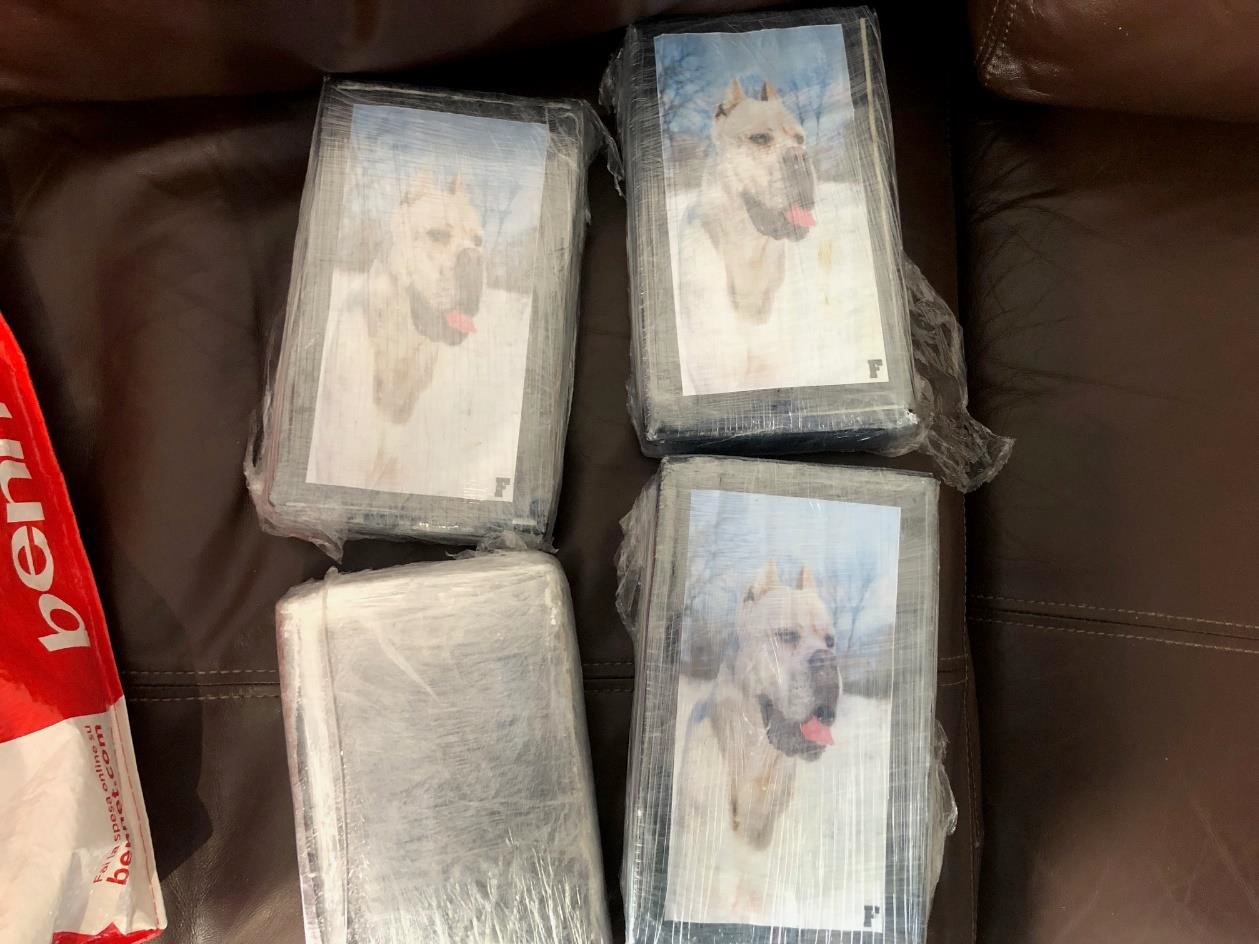


 In September 2016 the plot was foiled when an innocent Dutch haulage driver employed to collect and deliver the consignment smelled a rat. He returned to his depot and called the police who found eight 1kg bricks of cocaine.
 Kewin then claimed he owned the house and obtained the fraudulent mortgage, provided by a small finance company. The OCG used the landlord’s name to: open several bank accounts; create a company called Blackpool Fruit and Veg; and rent a warehouse in Leeds.
 Minister for Crime and Policing, Dame Diana Johnson said: “This was an extremely complex operation involving a huge number of agencies working together. My thanks go to every single officer who helped to bring these criminals to justice.




 Their convictions follow a National Crime Agency (NCA) investigation that led to NCA and Border Force officers discovering the drugs haul inside a shipping container at Tilbury Docks, Essex.
 Seemingly realising the drugs were missing, they all then fled the site in different cars, abandoning the load shortly after the container was opened.


 AVISEUR INTERNATIONAL