 By Mark Isaacs
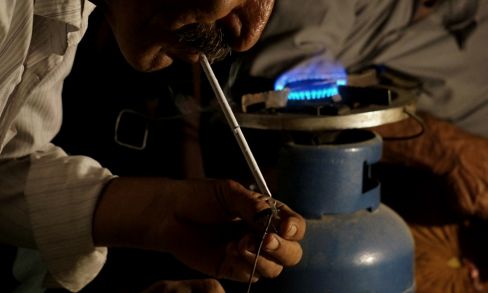
I am sitting in the corner of a tent with a group of nomadic people in the dusty highlands of southern Iran and the old men start smoking opium. A man with thick, white hair taps out the charcoal-like remains from a long, ornate pipe and starts compacting the substance together. Meanwhile, he heats a hot poker against the open flame of a gas cooker. When he has pressed the substance into a black button the size of his thumbprint, he applies a hot poker and the black button smokes softly. An alluring, sweet smell fills the room. He sucks up the smoke through a straw and his eyes glaze and shut a little as he enters a dreamy state.
Seeing men handle opium with such nonchalance shouldn’t come as a surprise. After all, we are a short distance from the world’s principal area of opium production: the mountainous border areas of Iran, Pakistan, and Afghanistan, known as the Golden Crescent. Ali tells me the men purchase their opium from Afghanistan for $4 per five grams. According to the United Nations, Afghanistan accounts for an estimated 85 percent of the world’s opium production, most of which is trafficked through Iran, the main transit point connecting Afghanistan and Pakistan to Europe. However, much of the opium trafficked into Iran never reaches Europe but is consumed domestically. According to Amnesty International, Iran is becoming a source country for, “the clandestine manufacture of methamphetamine, some of which is consumed domestically, but increasing amounts are trafficked to Malaysia, Indonesia, and other countries in Asia.”
Read more :
http://www.worldpolicy.org/blog/2016/09/15/smoking-opium-islamic-republic-iran
00000000000000000000000000000000000
 AVISEUR INTERNATIONAL