AVISEUR INTERNATIONAL

Aviseur International renseigne, sans complaisance, sur la problématique de la drogue, du narcotrafic, de la corruption et sur les politiques mises en œuvre par les différents Etats et les dérives que s'autorisent les fonctionnaires des administrations — aviseurinternational@proton.me — 33 (0) 6 84 30 31 81

AVISEUR INTERNATIONAL

DEA: d’ Haïti, le commissaire de police Télémaque Claude a été extradé vers les States

Extradition d’un commissaire de Police vers les Etats- Unis

Le commissaire de police Télémaque Claude qui était responsable du commissariat de Léogane a été arrêté pour son implication présumée, dans le trafic illicite de la drogue.

Il a été appréhendé par des agents de la Direction Centrale de la Police Judiciaire (DCPJ), a appris Radio Métropole de source policière.

Après son arrestation le haut gradé de la Police Nationale a été Conduit à la DCPJ , où il a été interrogé.

Il a été ensuite extradé vers les États-Unis, par le service de police fédéral américain Drug Enforcement Administration (DEA).

Les représentants des gouvernements américain et haïtien ont signé, le mercredi 15 mai 2002 , un protocole d’accord dans le cadre de la lutte contre le trafic de la drogue. L’administration des Etats-Unis va financer des projets dans les domaines techniques et éducatifs.

Les autorités de Port-au-Prince se sont entendues avec les Etats-Unis pour augmenter l’effectif des garde-côtes haïtiens, de la Brigade de Lutte contre le Trafic des Stupéfiants (BLTS) et fournir les ressources adéquates à la Police et à la justice.

Ce protocole d’accord de coopération entre Haïti et les Etats-Unis sur la lutte contre la drogue n’était pas le premier du genre.

EJ/Radio Métropole Haïti

http://www.metropolehaiti.com/metropole/full_une_fr.php?id=25325

0000000000000000000000

MAROC – Narcotrafic: complicité de l’armée marocaine avec le narcotrafic dénoncé dans un nouveau livre

Lire aussi: MAROC: l’une des richesses du roi, c’est le commerce international de la drogue (Narcotrafic)..

°°°°°°°°°°°°°°°°°°°°°°°°°°°°°°°°

A qui profite l’argent du cannabis ?

La liberté de la presse progresse au Maroc. Un site, Le gri-gri, ose publier un article très complet sur une grosse branche du marzen, le business industriel du haschich entre le royaume et l’Europe. Avec un blanchiment moyen de 120 000 euros tous les deux jours, c’est un potentiel d’environ 22 millions d’euros annuel (près de 32 millions CHF) pour une seule filière approvisionnant quatre pays. L’enquête a révélé que 5 millions d’euros avaient transité par les banques suisses, le reste est passé par des comptes israéliens ou a été converti en or pour le retour au bled.

Une entreprise qui ne connaît pas la crise

Ce montant astronomique doit encore être augmenté des frais généraux et des salaires des employés européens pour arriver à une estimation valable du chiffre d’affaire, probablement plus de 25 millions d’euros. Voilà ce qu’un réseau peut collecter et sortir de l’économie légale européenne, voilà ce que nous coûte la prohibition du cannabis. On imagine qu’avec de telles liquidités, il est aisé « d’acheter la route » comme disent les trafiquants pour parler de corruption.

Artisanat ou industrie ?

On pourrait penser que ce réseau est particulièrement gros et livre des marchés très dynamiques. Pas du tout. Un rapport du Health Research Board (HRB) pour 2003 estime à 374 millions d’euros annuel le marché de la résine de cannabis en Irlande, un pays de seulement 4 millions d’habitants. Il faudrait donc quinze filières comme celle décrite dans Le gri-gri rien que pour couvrir le marché de la lointaine Irlande. Ou bien cette filière n’est qu’artisanale, ce qui explique qu’elle est démantelée, et il existe bien plus gros. Ou bien de nombreux entrepreneurs au Maroc et en Europe se livrent au même trafic de fourmi. Certainement un mélange des deux.

Peu de pressions internationales

Tant tous les cas, ces sommes doivent profiter à beaucoup de patrons, banquiers, policiers, douaniers, hommes politiques au Maroc, c’est sans doute la principale ressource du pays après les devises des travailleurs immigrés. Dans un pays pauvre et corrompu, le marzen n’a pas de peine à se développer. Mais pour des volumes et des sommes pareilles, il faut aussi des complicités en Europe. Comment ce petit pays pourrait-il tenir tête à ses puissants voisins ? Pourtant, Mohamed VI est courtisé par tous les dirigeants européens alors que son pays nous pompe chaque année des milliards d’euros hors taxes.

L’économie gangrenée

L’argent du hasch est perdu pour l’impôt en Europe mais il permet au Maroc de payer les nombreuses entreprises européennes, surtout françaises, qui travaillent dans ce pays. Les entrepreneurs européens impliqués dans l’import ou le blanchiment réinvestissent leurs profits, souvent dans leurs entreprises qui deviennent florissantes au prix d’une concurrence déloyale pour les entrepreneurs honnêtes du même secteur. Les banquiers, pas seulement suisses, peuvent-ils encore se passer de ces capitaux flottants souvent disponibles pour des opérations à haut risque ? L’argent du hasch pervertit notre économie à haut niveau, nous sommes loin de l’imagerie d’Epinal des gangs de cités qui survivent grâce au shitstème. Bien au-dessus d’eux, on construit des routes, des usines ou des armes avec l’argent qu’ils collectent en bout de chaîne.

Des solutions ?

Pour justifier la prohibition, on peut disserter des heures sur le syndrome amotivationnel des ados qui abusent du joint, on peut ergoter sur les taux de THC, on peut s’empoigner sur la liberté de disposer de son corps et de son esprit… mais chaque année qui passe sans solution pragmatique gangrène un peu plus notre économie. Une dépénalisation de la consommation privée des adultes et de l’autoproduction pourrait diviser en deux le marché noir sans paraître trop incitatif pour la jeunesse puisqu’il n’y a pas de commerce, donc risque de prosélytisme. Une réglementation de la production et de la distribution à but non lucratif peut être envisagée, ces clubs seraient un recours au marché noir pour les adultes. Un marché réglementé comme pour le tabac et l’alcool aurait le plus d’impact économique mais ne garantirait pas forcément une bonne répartition socio-géographique des emplois. Il n’a jamais été question d’un marché libre, sans restriction d’age, de publicité, de santé publique.

Les solutions existent, plus de 100.000 Suisses ont signé l’initiative populaire pour un marché réglementé, cela correspondrait à environ un million de Français si ce système de démocratie directe existait dans ce pays. Ce processus est assez long et incertain, il ne concerne qu’un pays, il doit servir d’exemple mais à long terme. Devrons-nous attendre dix ans pour réformer cette aberration destructrice ? Oui, si nous ne faisons pas davantage entendre nos arguments partout où c’est possible.

Laurent Appel

°°°°°°°°°°°°°°°°°°°°°°°°°°°°°°°°°°

Maroc : à qui profite le kif ?

Le procès qui s’est ouvert au tribunal de Bobigny le 5 septembre 2005 met à jour les coulisses d’un trafic de hasch, de devises et de lingots d’or. Le Gri-Gri révèle l’implication de magnats marocains et de commerçants du Sentier.

Longtemps, les autorités marocaines ont rabâché une version : le trafic de cannabis est organisé par des mafias étrangères exploitant des paysans du Rif sous-payés. Seulement, en France, pas moins de cinq procédures judiciaires contredisent cette rengaine. À en croire les enquêtes policières qui ont disséqué le fonctionnement de ce juteux commerce, les gros bonnets sont des magnats marocains de l’import-export associés à des commerçants du Sentier, temple parisien de la fringue, originaires du Royaume.

Le 5 septembre, une de ces procédures a abouti à l’ouverture d’un procès fleuve à Bobigny, en banlieue parisienne. Les 26 prévenus, pour la plupart des Marocains, sont accusés d’avoir participé au blanchiment de l’argent du haschich et à son rapatriement sous forme de devises et de lingots d’or vers leur pays d’origine. Entre 100 000 et 140 000 euros tous les deux jours

Une filière entièrement pilotée à distance par des négociants basés au Maroc.

Parmi eux, les C., une famille de Nador, propriétaire d’échoppes de tissus et de cybercafés dans plusieurs villes du Royaume. Une couverture, soupçonne la justice française. Dans leurs arrière-boutiques, ces commanditaires délivrent leurs instructions au jour le jour à leurs intermédiaires basés sur l’autre rive de la Méditerranée. Leur station-service située à Nador sert de plaque tournante. À l’aller, les tonnes de résine de cannabis y sont embarquées à bord de camionnettes, de 4×4, voire de bus. Direction la France, la Belgique, l’Allemagne, et les Pays-Bas.

Au retour, c’est aussi là que les billets et lingots d’or sont déchargés. La fraîche est alors investie dans l’immobilier et dans la culture du chanvre. Et l’or, refourgué aux bijoutiers. Plus intrigant, A. T., l’un des accusés-clés de ce procès (qui comparaît libre !), n’est autre que le bras droit d’un personnage fort connu : …. Soupçonné de blanchiment d’argent par la justice française, ce Franco-Marocain a été arrêté en avril 2004 à l’aéroport de New York et discrètement extradé vers Paris. Très proche, sous le règne d’Hassan II, de Mohamed Médiouri, puissant patron de la sécurité du Palais royal, il est le fils de …, un richissime homme d’affaires du Royaume qui a fait fortune dans le négoce de la ferraille et des engins de travaux publics. Un patriarche si influent qu’il a obtenu que son fils et son acolyte soient défendus par P. H., une star du barreau parisien, également avocat de M. R. (né au Maroc et ami de la couronne), de L. G. et de feu A. S.

D’après les écoutes téléphoniques, A. T., employé de … dans son magasin du Sentier, joue également les coursiers pour le compte de son patron, faisant la navette entre Paris et Lyon pour rapporter des sacs de sport bourrés de billets. Des sommes qu’il confie illico aux bons soins de M. C., collecteur en chef présumé du réseau, basé à Paris. Ce plombier de formation est soupçonné d’avoir organisé le ramassage, le blanchiment et l’expatriation hors de France de la totalité de l’argent issu de la vente du hachisch. Look gentillet, tempérament réservé, ce Marocain de 29 ans a toutes les qualités pour remplir sa discrète mission. De jour comme de nuit, il sillonne l’Hexagone et même l’Europe à bord de sa Mercedes pour récupérer le magot. En province, il ne se déplace jamais pour moins d’un « mètre », soit 100 000 euros dans le jargon des trafiquants. Début 2003, il aurait ainsi collecté 3,2 millions d’euros en deux mois.

Une fois l’argent récolté, l’efficace M. C. s’en débarrasse dans les 48 heures. Le grisbi est d’abord stocké à Clichy-la-Garenne chez A. B. dit le « Boupastélé » (le boulanger en arabe). Un modeste commerçant, en apparence, qui possède tout de même un million d’euros, trois boulangeries et une demi-douzaine d’appartements.

Puis une partie des espèces est écoulée via des comptes bancaires suisses et israéliens. Au total, 5 millions d’euros auraient transité vers le « pays propre », nom de code désignant la Confédération helvétique. Là, détail troublant, dans le dossier apparaît un nom donnant un tout autre relief à l’affaire : J. M.. Du fait de ses liens avec S. H., autre sommité marocaine, ce banquier suisse fait l’objet d’un mandat d’arrêt délivré par le juge d’instruction Philippe Courroye pour blanchiment de capitaux provenant de crimes et délits dans le cadre de l’enquête sur les ventes d’armes à l’Angola.

Quant au reste du pactole, M. C. en convertit une grande partie en or. Chaque semaine, il commande entre 30 et 50 « fèves » auprès de deux agents de change de la Bourse et du Panthéon, à Paris, également poursuivis dans ce procès.

Dernière étape, l’expédition des devises restantes et des lingots vers le Maroc. Le trésor est planqué dans les portières et sièges des voitures confiées à des passeurs marocains, visiblement sélectionnés pour leur allure de bon père de famille. Le principal d’entre eux, A. M.. Bien qu’il soit surnommé « Khadafi », ce retraité de 62 ans, père de 6 enfants, n’a rien d’un bandit de grand chemin : petite moustache, lunettes rondes, visage poupin et aspect bonhomme. Et pourtant, il aurait transporté plus de 600 lingots. C’est lui qui, fin avril 2003, sera arrêté avec 400 000 euros camouflés dans sa vielle fourgonnette Mercedes.

Une interpellation qui permettra aux policiers de démanteler la branche française de ce réseau. Mais ils ne parviendront pas à remonter jusqu’aux commanditaires marocains. Seuls quatre mandats d’arrêts seront délivrés à l’encontre de membres du clan C.. Des mandats restés lettre morte. Plus curieux encore, malgré l’ampleur du trafic, aucun flic, ni douanier, ni gendarme du Royaume n’est inquiété. La complicité des douanes de Tanger ou d’ailleurs reste encore et toujours la partie la plus immergée de l’iceberg.

Les amis du gri-gri

SOURCE: http://www.chanvre-info.ch/info/fr/A-qui-profite-l-argent-du-cannabis.html
Avatar de Marc FievetThe international informant

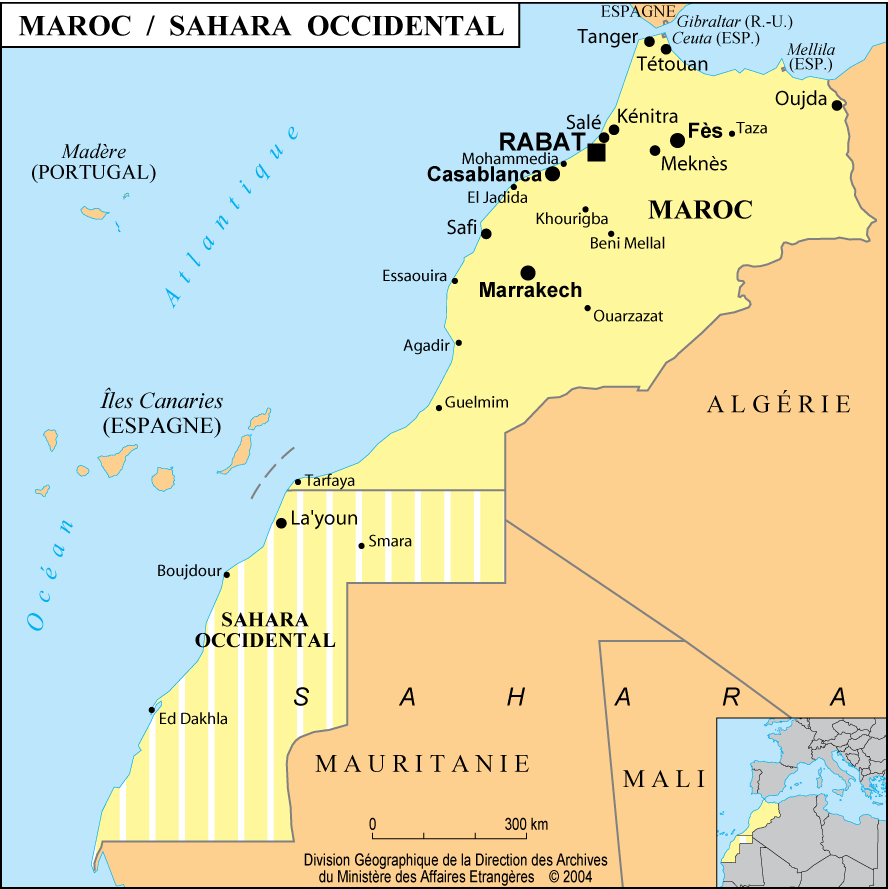
Abdelaziz Bennani Bennani, général dénoncé par l’auteur

Un ancien officier de l’armée marocaine, Abdelila Issou, âgé de 49 ans, raconte dans ses mémoires le business obscur du Général Bennani, le chef de l’Etat Major des troupes marocaines opérant au Sahara Occidental. Selon lui il aurait ouvert les portes aux cartels colombiens pour qu’ils puissent introduire la cocaïne en Espagne.
Diplômé à l’Académie Royale militaire de Meknès, il a fini par travailler pour les services secrets espagnols, CNI, avant de s’exiler en Espagne en 2000.
Dans son livre « Mémoires d’un soldat marocain La Face cachée du royaume enchanté », Issou dénonce la corruption de la plus haute hiérarchie militaire marocaine en apportant des preuves accablantes de la complicité de l’armée marocaine avec le trafic de drogue.
Le lieutenant Abdelillah Issou commandait une unité qui patrouillait entre Cap Malabata, entre Tanger et Ceuta. Sa tournée commençait tous les jours à 21h02…

Voir l’article original 152 mots de plus

Canadian citizen Armitdeep Mann, 33, of Toronto, Canada, was sentenced today to five years and one month

Final Defendant Sentenced in Scheme to Use Fresno Trucking Front to Smuggle Cocaine into Canada

SEP 15 (FRESNO, Calif.) – Canadian citizen Armitdeep Mann, 33, of Toronto, Canada, was sentenced today to five years and one month in prison by United States District Judge Anthony W. Ishii for conspiracy to distribute and possess with the intent to distribute cocaine.

According to court documents, between July 1, 2012, and September 21, 2012, Mann and others conspired to smuggle cocaine into Canada by concealing it in legitimate cargo. On September 21, 2012, agents followed one of Mann’s co-conspirators as he went to Los Angeles to deliver eight kilograms of cocaine. Law enforcement seized that cocaine and arrested Mann and additional defendants. A search warrant at the Los Angeles residence where authorities believed the eight kilograms of cocaine had been stored resulted in the seizure of an additional 40 kilograms of cocaine. Mann has been held in custody without bail since his arrest.

On April 7, 2014, co-conspirator Manjot Nanner, 32, of Fresno, was sentenced to one year and 10 months in prison, and on June 2, 2014, co-conspirator Vincent Rivaz-Felix, 29, of Los Angeles, was sentenced to four years and three months in prison for the conspiracy.

This case was the product of an investigation by the Organized Crime Drug Enforcement Task Force, the Drug Enforcement Administration, Fresno Police Department, and the Fontana and Vernon Police Departments. Assistant United States Attorney Kevin Rooney prosecuted the case.

This case was part of an Organized Crime Drug Enforcement Task Force (OCDETF). The OCDETF Program was established in 1982 to conduct comprehensive, multi-level attacks on major drug trafficking and money laundering organizations. The principal mission of the OCDETF program is to identify, disrupt, and dismantle the most serious drug trafficking and money laundering organizations and those primarily responsible for the nation’s drug supply

000000000000000000000000000000

CHICAGO (AP) — The head of the Drug Enforcement Administration’s…

DEAAPNewsBreak: Chicago DEA chief heading to DC. FILE – In this Dec. 11, 2012 file photo, Jack Riley, center, head of the Drug Enforcement Administration in Chicago, points out local Mexican drug cartel problem areas on a map in Chicago. Riley who has been outspoken about the growing influence of Mexican cartels in the American heartland is leaving Chicago to take one of the agency’s top posts in Washington, D.C. Riley has been named as the DEA’s new chief of operations and will be responsible for overseeing all agency law enforcement within the United States and international. Photo: M. Spencer Green, AP
CHICAGO (AP) — The head of the Drug Enforcement Administration's...APNewsBreak: Chicago DEA chief heading to DC.

CHICAGO (AP) — The head of the Drug Enforcement Administration’s Chicago division, who has drawn attention to the growing influence of Mexican cartels in the American heartland, is leaving to take one of the agency’s top posts in Washington, D.C., a DEA official said Tuesday.

Jack Riley, 56, has been named the DEA’s new chief of operations — considered the federal agency’s No. 3 position — and will oversee all agency enforcement activities within the U.S. and internationally, Rusty Payne, a spokesman with the DEA in Washington, told The Associated Press.

In an interview at his office Tuesday, Riley said the two biggest changes in the trafficking landscape since he came to Chicago in 2010 have been the entrenchment of Mexico’s cartels in the Midwest and the resurgence of heroin, including in suburban neighborhoods.

Heroin has become more popular, in part, because it’s now available in easier-to-use powder form and can be snorted rather than having to be injected with needles, he explained.

« People who never would have done heroin are doing it today, » Riley said.

As the special agent in charge in Chicago, Riley has directed DEA operations in Illinois, Indiana, Wisconsin, Minnesota and North Dakota. His previous posts included head of the agency’s El Paso, Texas, office.

In recent years, Riley highlighted how Mexican cartel operatives had pushed deep inside the U.S., including Chicago, which has become a hub through which the syndicates distribute drugs farther afield.

« They’ve cemented themselves, » Riley said.

Riley also backed the creation of a Chicago Strike Force headquarters, which opened last year. At the new facility, federal agents, police and prosecutors work together year-round, often targeting the point of contact between cartel-backed traffickers and local gangs who serve as street-level salesmen.

In 2013, Riley joined the non-governmental Chicago Crime Commission in naming Sinaloa cartel boss Joaquin « El Chapo » Guzman, as the city’s new Public Enemy No. 1 — the same label once assigned to gangster Al Capone.

Mexican authorities captured Guzman earlier this year; they haven’t indicated whether he might be extradited to face trial in Chicago or another American city.

Riley is expected to begin his new job next month. His replacement in Chicago has not been named.

SOURCE: http://www.mynextfone.co.uk/breaking-news/chicago-ap-the-head-of-the-drug-enforcement-administrations-h26851.html

0000000000000000000000000000

Opération DINERO: le résumé actuel de l’opération du DEA écarte pour toujours la DNRED!

Les « historiens » du DEA semblent refaire l’histoire de cette opération à laquelle a participé la DNRED!

Operation Dinero (1994)
Operation Dinero, a joint DEA/IRS (Internal Revenue Service) operation, was launched by the DEA’s Atlanta Division in 1992. In this investigation, the U.S. Government successfully operated a financial institution in Anguilla for the purpose of targeting the financial networks of international drug organizations. In addition, a number of undercover corporations were established in different jurisdictions as multi-service “front”businesses designed to supply “money laundering” services such as loans, cashier’s checks, wire transfers, and peso exchanges, or to establish holding companies or shell corporations for the trafficking groups. Believing these services were legitimate, the Cali mafia engaged the bank to sell three paintings, a Picasso, a Rubens, and a Reynolds. These paintings, estimated to have a combined value of $15 million, were seized by the DEA and IRS in 1994. The operation resulted in 116 arrests in the United States, Spain, Italy, and Canada and the seizure of nine tons of cocaine, and the seizure of more than $90 million in cash and other property. The two-year joint enforcement operation was coordinated by the DEA, IRS, INS, FBI, and international law enforcement counterparts in the United Kingdom, Canada, Italy, and Spain.

SOURCE: http://www.justice.gov/dea/about/history/1994-1998.pdf

0000000000000000000000000000000000000000000000

MAROC: l’une des richesses du roi, c’est le commerce international de la drogue (Narcotrafic).

Avatar de Marc FievetThe international informant

Maroc: révélations accablantes de l’ex-officier des services secrets marocainsVu ses révélations accablantes sur les vérités de la monarchie marocaine et ses services d’espionnage dans les enlèvements, la torture et le trafic de drogue, on vous présente la traduction intégrale de l’interview de l’ex-officier marocain des services secrets comme publiées dans le journal Echourouk “Echoroque”http://www.echoroukonline.com/ara/articles/209832.html
Quelles sont les raisons qui vous ont poussés à quitter les services secrets marocains, et quelles sont les tâches qu’on vous a consignés?

Maroc: révélations accablantes de l’ex-officier des services secrets marocainsTous d’abord je dois remercier le journal d’Echoroque et son équipage d’avoir offert cette occasion qui est rare dans mon pays bien-aimé à cause des pratiques sordides du Makhzen qui impose la censure contre toutes les voies libres qui demandent le changement, la liberté et la vraie démocratie.

Revenons à votre question, l’une des raisons qui m’a poussé à quitter les services secrets marocains est l’absence d’une loi qui encadre ces services et définit leur mission. Au même temps, il…

Voir l’article original 1 716 mots de plus

East Lancasshire (UK) – Narcobusinessman Darren Bowling involved in a conspiracy to supply class A and class B drugs and money laundering

Lancashire Telegraph: Businessman Darren BowlingA ‘NOTORIOUS’ drug dealer was living a luxury lifestyle while peddling thousands of pounds of cocaine and cannabis.

Businessman Darren Bowling was involved in a conspiracy to supply the drugs which spread across the North West and the entire country, police said.

Investigators said breaking up the gang represented a ‘massive dint’ in the importation and selling of class A and B drugs in East Lancashire.

Police said Bowling had been living in a luxury €1.5million villa in Malaga, complete with swimming pool and had properties in Bulgaria as

well as a converted barn in East Lancashire.

Lancashire Telegraph: Businessman Darren BowlingThe 48-year-old drove a Porsche Cayenne with a personal number plate 36 BOW and also had a brand new Volkswagen Golf.

He owned his own storage company in Hapton as well as a car sales business in Burnley and had a stake in a popular town centre bar.

But despite all of this, police said they had never seen him do a hard day’s work.

Officers said Bowling teamed up with Paul Bell, 49, from Cheadle, and alleged dealer Michael Donnelly, to set up an underground drugs business.

Donnelly has not been seen since he fled the United Kingdom to South Africa via Dubai in September last year.

Bowling, who admitted, conspiracy to supply class A and class B drugs and money laundering, was living the life of a millionaire while organising drug deals police said.

Speaking after the hearing Det Insp Martin Kane, who led the year-long serious and organised crime unit investigation, said: « In my experience of investigating organised crime, Darren Bowling was certainly one of those individuals that lived a fantastic luxury lifestyle from the proceeds of crime.

« From our investigation, we know that he owns property in Spain and Bulgaria and has a converted barn-style house in Barrowford. He owns the Castle Mill premises, Mojitos bar and the Castle Car Sales and he drove around in a Porshe.

« But we never saw him do a hard day’s work, despite him owning all these things.

« There is no doubt Bowling has become a very wealthy man over the years from importing and supplying cocaine into the United Kingdom and Lancashire. »

Dennis Bury, who co-owned Mojitos bar with Bowling, of Colne Road, Barrowford, said he bought his business partner’s share as soon as the allegations against him came to light.

He said: “Mojitos has nothing more to do with Bowling. That company ceased trading and Dennis Bury Ltd bought it.

“I wanted nothing to do with him and I had no idea what was going on.”

The police’s Operation Victor investigation, which saw officers seize more than 2kgs of cocaine, 15kgs of amphetamine, cannabis and £200,000 in cash, came to a head in January.

They had been monitoring Bowling’s activities, which included him frequently heading to his properties in Spain to arrange for cocaine to be imported to the UK.

He would then meet up and talk with his co-conspirators to organise deals.

Also involved in the conspiracy was Mark Waring, 39 of Peel Mount, Blackburn. He was described as a courier for Donnelly and pleaded guilty in December 2013 to possession with intent to supply 2kgs of cocaine and production of cannabis. He was sentenced to seven years imprisonment.

Shaun McDonald, 37, of Colshaw Road, Manchester, was a courier for Bell, who had only been out of prison for a short while after being sentenced to 20 years in 2003 for being part of a gang that imported drugs with a street value of £200million, when he got involved with the conspiracy.

McDonald admitted being in possession with intent to supply 15kgs of amphetamine and money laundering in October 2013 and was sentenced to three years four months behind bars.

Stephen Barton, 42, of Brandy House Brow, Blackburn, was a customer of Donnelly and was found guilty of conspiracy to supply class B drugs at Preston Crown Court. He was cleared of charges of possessing criminal property.

Barton stood trial alongside Melvin Harrison, 52, of Causey Foot, Nelson, who faced two charges of concealing criminal property. He was an employee of Bowling who had worked for the family company for 27 years.

The court heart how he admitted creating a hide from a cardboard box with a metal container inside for his boss at Castle Storage, Hapton but denied he knew or suspected the cash inside to be ‘dirty’ drugs money. He was found not guilty on both charges.

Det Insp Kane said: « This investigation is another example of Lancashire’s serious and organised crime unit’s relentless effort to combat the supply of controlled drugs.

« Drugs like cocaine cause misery to communities. The amount of cocaine and the scale of the supply of it on the streets of Lancashire can never be underestimated.

« We are now continuing to investigate the properties and wealth Bowling has amassed over the years to support proceeds of crime proceedings later this year. »

The gang will be sentenced on October 10.

source:http://www.lancashiretelegraph.co.uk/news/11428803._Notorious__East_Lancs_cocaine_kingpin_s_life_of_luxury/?ref=var_0

000000000000000000000000000000000000000000000

MIAMI NEWS (USA): Diego Perez Henao, colombian Narcotics Kingpin, sentenced to 360 Months in Prison

http://diarioadn.co/actualidad/colombia/extradici%C3%B3n-a-ee-uu-de-alias-diego-rastrojo-1.74146

August 6, 2014
Contact: Public Information Officer
Number: 954-660-4602

AUG 06 (MIAMI) – Mark R. Trouville, Special Agent in Charge, Drug Enforcement Administration (DEA), Miami Field Division, Wifredo A. Ferrer, United States Attorney for the Southern District of Florida, and George L. Piro, Special Agent in Charge, Federal Bureau of Investigation (FBI), Miami Field Office, announce that U.S. District Judge Patricia A. Seitz sentenced Diego Perez Henao, a/k/a “Diego Rastrojo,” 43, a Colombian national, to 360 months in prison. Perez Henao was also ordered to forfeit $1,000,000 to the United States.

Perez Henao had been indicted by a federal grand jury on February 8, 2011, and previously pleaded guilty on January 24, 2014, to a single count of conspiring with others to manufacture and distribute five or more kilograms of cocaine from 1993 until February 2011, knowing that the cocaine would be imported into the United States.

Perez Henao acknowledged that he was involved in the manufacture, investment or shipment of in excess of 81,100 kilograms of cocaine during the timeframe of his conspiracy.  He further acknowledged that he controlled numerous armed workers in his organization and used both airplanes and semi-submersibles to ship the cocaine north from South America to points in Central America and Mexico – en route to its eventual destination of the United States.

Following Perez Henao’s indictment, the U.S. Department of State offered a reward of up to $5 million for information leading to his capture. Perez Henao was ultimately captured by Venezuelan authorities in Venezuela on June 3, 2012. The Venezuelan authorities sent Perez Henao to Colombia, which in turn extradited Perez Henao on August 28, 2013, to the United States to face the current charges.

DEA Special Agent in Charge Mark R. Trouville stated, “Diego Perez Henao, one of the last leaders of the North Valley Cartel, was responsible for smuggling more than 80 tons of cocaine into the United States.  He used violence and intimidation to line his greedy pockets at the expense of his own people and had no regard for those who would consume this addictive poison. Today’s sentencing is a reminder that there is no place to hide, the DEA along with our domestic and international law enforcement partners will continue to pursue and prosecute those who engage in drug trafficking into our borders.”

“For over a decade, Perez Henao – one of the most powerful and prolific drug lords in recent history – controlled dozens of heavily-armed workers in his drug trafficking organization and oversaw the manufacture and distribution of over 80 tons of cocaine into the United States,”  said U.S. Attorney Ferrer. “Perez Henao will now spend the next three decades of his life in prison.  With this sentence, one of the largest cartel heads in Colombian history was brought to justice.”

“Diego Perez-Henao was a notorious, international drug kingpin who for years profited from the shipment and sale of illegal drugs,” said Ken Sena, Acting Assistant Special Agent in Charge, FBI Miami. “His illicit career was brought to an end through close cooperation with our law enforcement partners.”

The indictment of Perez Henao is the result of an ongoing Organized Crime Drug Enforcement Task Force (OCDETF) led by DEA and FBI. The principal mission of the OCDETF program is to identify, disrupt and dismantle the most serious drug trafficking, weapons trafficking and money laundering organizations, and those primarily responsible for the nation’s illegal drug supply.
This investigation was conducted by the DEA, FBI, the DEA Andean Region and their Colombian law enforcement partners. The case was prosecuted by the U.S. Attorney’s Office for the Southern District of Florida.

SOURCE: http://www.justice.gov/dea/divisions/mia/2014/mia080714.shtml

00000000000000000000000000000000000000000000000

BROOKLYN, N.Y.(USA): Leader of Maritime International Drug Transportation Organization Arraigned in Brooklyn

August 18, 2014
Contact: Public Information Officer
Number: 212-337-2906

The defendant allegedly transported thousands of kilograms of cocaine by boat and submarine

AUG 18 (BROOKLYN, N.Y.) – Earlier today, Jair Estupinan-Montano was arraigned at the federal courthouse in Brooklyn, New York, on charges relating to international narcotics trafficking. Estupinan- Montano was arrested in Panama on October 14, 2013, on a provisional arrest warrant issued from the Eastern District of New York.

The arraignment was announced by Loretta E. Lynch, United States Attorney for the Eastern District of New York, and James J. Hunt, Acting Special Agent in Charge, Drug Enforcement Administration (DEA), New York Division.

According to court filings, prior to his arrest, Estupinan-Montano was the leader of a narcotics trafficking organization responsible for transporting shipments of cocaine from Colombia to locations in Central America and Mexico for ultimate delivery to the United States. Estupinan-Montano allegedly worked closely with the violent “Los Rastrojos” drug trafficking organization, a paramilitary organization that employed hundreds of individuals and controlled drug trafficking along the Pacific coast of Colombia.

Estupinan-Montano was responsible for arranging boats and submarines that transported the cocaine from Colombia to other members of his organization in Central America, who then transported the cocaine north to be sold to Mexican cartels for eventual shipment to the United States. A detention memo filed today by the government details that, between 2010 and 2012, the United States Coast Guard seized two ships and a semi-submersible vessel that had been sent from Colombia by Estupinan-Montano. In total, those vessels contained over 7,200 kilograms of cocaine when they originally left South America.

“Evoking Jules Verne, the defendant Estupinan-Montano relied on boats and submarines to ferry his illegal cargo, and was an essential link in the flow of illegal narcotics from Colombia to the United States,” stated United States Attorney Lynch. “The illegal narcotics trade is a scourge, both in the United States and throughout the world. With the help of our international allies, we will continue to strike at those who enrich themselves off this violent industry wherever they are found.” Ms. Lynch thanked the New York Drug Enforcement Task Force, comprised of officers and agents of the DEA, New York City Police Department and the New York State Police; the DEA’s Bogota Country Office and Panama Express Task Force; the United States Coast Guard; the Department of Justice Office of International Affairs; and the Republic of Panama for their help in investigating and capturing Estupinan-Montano.

The defendant was arraigned this afternoon before United States Magistrate Judge Steven M. Gold at the federal courthouse in Brooklyn. The charges in the indictment are merely allegations, and the defendant is presumed innocent unless and until proven guilty.

The government’s case is being prosecuted by Assistant United States Attorneys Tyler Smith, Amir Toossi, Justin Lerer, and Robert Polemeni.

The Defendant:
Jair Estupinan-Montano
Age: 31
COLOMBIA

E.D.N.Y. Docket No. 12-CR-793 (SLT)

Dallas (USA): Dallas Man Sentenced to Serve 25 Years in Federal Prison on Drug Trafficking and Money Laundering Convictions

AUG 18 (DALLAS) —A Dallas man who pleaded guilty to felony offenses stemming from his role as a major participant in a marijuana distribution conspiracy operating in north Texas was sentenced this morning in federal court in Dallas, announced U.S. Attorney Sarah R. Saldaña of the Northern District of Texas.

Andres Hernandez, Jr., a/k/a “Gordo,” 34, was sentenced by U.S. District Judge Sam A. Lindsay to serve a total of 300 months in federal prison.  Hernandez pleaded guilty in September 2013 to one count of conspiracy to distribute 100 kilograms or more of marijuana and one count of money laundering.  Judge Lindsay sentenced him to 25 years on the drug conspiracy conviction and 10 years on the money laundering conviction, to run concurrently.

Hernandez and others were arrested on November 1, 2012, following a law enforcement operation led by the Drug Enforcement Administration (DEA) and the North Texas High Intensity Drug Trafficking Area (HIDTA) task force, during which federal search warrants were executed at various locations, including Hernandez’s residence on W. Colorado Blvd. in Dallas.  At his residence, law enforcement located approximately 20 pounds of marijuana, digital scales and a loaded firearm.  Hernandez has remained in custody since his arrest.
According to documents filed in the case, Hernandez admitted that on multiple occasions between January 2011 and the date of his arrest, he received multi-pound quantities of marijuana from several supply sources, including co-defendants Serviano Contreras, a/k/a “Seven” and “Junior,” 27, and Virgilio Espinosa Delacruz, a/k/a “Chaparro,” 41.  Hernandez admitted that he stored this marijuana both at his residence and at the residence of co-defendant Benicio Pena, Jr., a/k/a “Nene,” 63, on Lourdes Street in Dallas.  Contreras, Delacruz and Pena pleaded guilty to their respective roles in the conspiracy and are serving federal prison sentences of 48 months, 44 months, and 42 months, respectively.

Hernandez admitted that he routinely distributed multi-pound quantities of marijuana to co-defendants Jarvis Holmes, 43; Claudia Castillo, 21; Jerry Cardenas, 32; Lamont Morgan, 35; Roberto Lopez Delacruz, 27; and Paul Santoy, 28.  They each pleaded guilty to their roles in the conspiracy.  Holmes was sentenced to 51 months; Cardenas, 48 months; Morgan, 46 months; Roberto Delacruz, 16 months; and Santoy, 15 months.  Claudio Castillo is scheduled to be sentenced on November 17, 2014.

Hernandez further admitted that in March 2012, an individual purchased a parcel of land located in Barry, Texas, using $28,854 in cash provided by Andres Hernandez’s wife, Griselda Hernandez, 34. That same day, that individual deeded the property to Andres and Griselda Hernandez.  Andres Hernandez admitted that the cash used to purchase the property included drug proceeds.  Griselda Hernandez also pleaded guilty to her role in the conspiracy and was sentenced to 57 months in federal prison. Assistant U.S. Attorney Phelesa Guy was in charge of the prosecution.

SOURCE: http://www.justice.gov/dea/divisions/dal/2014/dal081814.shtml

000000000000000000000000000000000000000000000000000

Vermont (USA): Bunthan Sam Sentenced to 10 Years for Conspiracy to Distribute Heroin

Bunthan Sam Sentenced to 10 Years for Conspiracy to Distribute Heroin

AUG 18 (BURLINGTON, Vt.)- Michael J. Ferguson, Acting Special Agent in Charge of the Drug Enforcement Administration for New England and The Office of the United States Attorney for the District of Vermont stated that Bunthan Sam, 35, of Chicago, Illinois, was sentenced to 120 months in prison, having pleaded guilty to the charge of conspiracy to distribute at least 100 grams of heroin. United States District Judge William K. Sessions III, sitting in Burlington, also sentenced Sam to 4 years of supervised release.

Court records show that Sam, who went by the alias Adam or Taun, sold heroin in the Burlington area over a period of about two years. He obtained this heroin from suppliers in Chicago and Connecticut. Sam was arrested on the conspiracy charge in Chicago on July 24, 2013, and incarcerated thereafter.

Court records further show that Sam is a member of a larger group with ties to Chicago; Lowell, Massachusetts; and Connecticut that distributed an especially strong form of heroin in the Burlington area from about mid-2011 through the time of the arrest of Sam’s brother, codefendant Chandara Sam, on April 10, 2013. Chandara Sam, who went by the alias Po, was taken into custody in White River Junction, after selling approximately 40 grams of heroin to an individual cooperating with law enforcement. Some of the heroin sold by the conspiracy was known as Chi town or Chi, short for Chicago, and has caused several overdoses in the last several years. The Vermont State Police Drug Task Force began an investigation into Sam’s heroin ring in December 2011.

In January 2013, members of the Essex Police Department and the Drug Enforcement Administration arrested two individuals, Edward Chavin, also known as Tommy, and Christopher Nason in the Handy’s Suites in Essex. Chavin was found in possession of more than 100 grams of heroin. He and Nason were subsequently indicted for conspiracy to distribute 100 grams or more of heroin, and both have pleaded guilty. The Handy’s Suites raid occurred following a heroin overdose in a nearby room. Investigation revealed that Chavin, Nason, and the Sams were part of the same heroin ring, and that Chavin had been transporting heroin from Chicago to the Burlington area for nearly a year prior to his arrest.

In early June 2014, one of conspiracy leaders, codefendant James Nastri, of Deep River, Connecticut, was convicted of conspiracy to distribute at least 100 grams of heroin following a jury trial before Judge Sessions in Burlington.

Court records further reveal that Bunthan Sam possessed handguns at various points during the Vermont heroin trafficking conspiracy. Sam also has a criminal history that includes numerous prior felony offenses, violent offenses, and several instances of unlawful weapons and firearms activity.

For his crime, Sam faced a maximum penalty of 40 years in prison. In sentencing Sam, Judge Sessions noted the devastating impact heroin has had on Vermont communities, citing specifically the potency of the heroin Sam sold. Judge Sessions further noted that Sam had continued to sell heroin after learning that a person had overdosed on the Chi-town heroin and after Lowell, Massachusetts police pulled him over and seized a firearm from his vehicle, resulting in a felony charge.

The investigation was a collaborative effort of the Vermont State Police Drug Task Force; the Drug Enforcement Administration; the Bureau of Alcohol, Tobacco, Firearms, and Explosives; the Essex, Burlington, and South Burlington Vermont Police Departments; and the Lowell, Massachusetts Police Department.

SOURCE: http://www.justice.gov/dea/divisions/bos/2014/bos081814.shtml

000000000000000000000000000000000000000

DEA reports ‘big’ heroin bust in Salt Lake Valley

DEA(KUTV) The Drug Enforcement Administration said it was hidden in soles of shoes, pop-up car cup holders—but now, 31 pounds of heroin linked to a Mexican drug cartel are no longer headed to feed Utah addictions.

« This is a big deal, » said Nicki Hollmann, DEA Assistant Special Agent in Charge for Utah.  « There are significant supplies of heroin coming into Utah than were coming in a decade ago. »

°°°°°°°°°°°°°°°°°°°°°°°°°°°°°°°

SALT LAKE CITY — Federal drug agents have seized 31 pounds of heroin and more than 21 suspects have been arrested in a series of drug busts across the Salt Lake Valley.

The busts have put a dent in the drug trade and importation of heroin in Utah, the U.S. Drug Enforcement Administration said at a Thursday news conference.

“There are significant drug trafficking organizations operating from Mexico and our southern borders and supplying Utah with significant amounts of heroin,” said Nicki Hollmann, the assistant special agent-in-charge of the DEA.

The busts were carried out across the valley from February until now with a majority of the arrests being made in April.

Salt Lake County District Attorney Sim Gill said charges for those arrested ranged from drug distribution to racketeering.

more: http://fox13now.com/2014/08/21/31-lbs-of-heroin-seized-in-major-drug-bust-in-the-sl-valley/

0000000000000000000000000000000000000000000

Drug trafficking: 6 suspects arrested at Panama border with cocaine, drugs and DEA vests

Drug trafficking

Zach Dyer

Costa Rican police arrested six men near the country’s southern border with Panama with cocaine, guns and four vests bearing the initials of the U.S. Drug Enforcement Administration, according to a statement Sunday.

At a press conference Monday morning, Public Security Minister Celso Gamboa said authorities found 121 kilograms of packaged cocaine and several guns in a white van transporting three Panamanians in the possession of four vests bearing the letters “DEA.” Inside the van, police also found emergency response sirens. The minister said the Panamanian suspects appeared to have stolen the drugs and possibly the weapons from two Costa Rican suspects, a father and son with the last names Campos Morales and Campos Torres, respectively, who were found beaten in a truck in Cuervito, Puntarenas. The two Costa Rican men also were taken into custody.

National Police stopped the van in La Cuesta, Puntarenas, near the Panamanian border. As police approached, the suspects began throwing packages of cocaine out of the vehicle’s windows. Along with the cocaine, police discovered 10 weapons, including several 9 mm pistols and submachine guns.

A sixth suspect, whose nationality police did not name, was arrested later in Panama, according to an updated statement from the ministry.

The vehicle was taken to Paso Canoas for further investigation. The suspects have been handed over to the Prosecutor’s Office.

source/ http://www.ticotimes.net/2014/08/18/6-suspects-arrested-at-panama-border-with-cocaine-drugs-and-dea-vests

000000000000000000000000000000000000000000000000

DEA may be losing the war on marijuana politics

DEAFor narcotics agents, who often confront hostile situations, Capitol Hill has been a refuge where lawmakers stand ready to salute efforts in the nation’s war on drugs.

Lately, however, the Drug Enforcement Administration has found itself under attack in Congress as it holds its ground against marijuana legalization while the resolve of longtime political allies — and the White House and Justice Department to which it reports — rapidly fades.

« For 13 of the 14 years I have worked on this issue, when the DEA came to a hearing, committee members jumped over themselves to cheerlead, » said Bill Piper, a lobbyist with the Drug Policy Alliance, a pro-legalization group. « Now the lawmakers are not just asking tough questions, but also getting aggressive with their arguments. »


To read:http://www.latimes.com/nation/la-na-0713-dea-20140712-story.html#page=2
00000000000000000000000